
Menu
  • Home
  • Daily Devotions
  • The Podcast
  • Meet (in)courage
    • Meet the Contributors
    • Meet the Staff
    • About Us
    • Our History
  • Library
    • The (in)courage Library
    • Bible Studies
    • Freebies!
  • Shop
  • Guest Submissions
  • DaySpring
  • Privacy
  • Skip to primary navigation
  • Skip to main content
  • Skip to primary sidebar
(in)courage - Logo (in)courage

(in)courage

How God Cared for Us Through School Lunches

How God Cared for Us Through School Lunches

August 8, 2021 by Anna E. Rendell

I know — school lunches? It’s still summer! But recently, I was talking about school lunches and the normalcy they’ve provided us throughout the past year. School lunches, of all things, have served as a reminder to me that God sees, knows, and cares for us even in the smallest of ways. Here’s how:

In March 2020, we started hearing about this new disease called COVID. People were saying it was coming and that we’d better buy toilet paper and water bottles.

(I still have ten bottles of purified water in the basement that I bought in case the water plant people couldn’t come in to work and get the water going. I wish I was kidding.)

My kids came home from school one day and never got to go back to their classrooms. Do you remember that day too? They came home and ended up doing distance learning from March 19, 2020 till June 2, 2021. That was sixty-one weeks without in-classroom school. Right about 300 days of school from the dining room table, their at-home desks, the backyard, and sometimes the van.

We logged in to preschool, first grade, and third grade from iPads. The kids learned how to use Schoology and Seesaw and Media Center. They had Lunch Bunch, where the kids ate “together” as if they were in the cafeteria, except they were on Google Meet.

Everything was so weird. It still is — less weird but still getting there.

As parents, my husband and I did our best to keep things as normal as possible, but we were both working from home and occasionally relying on the occasional instant cash advance app to put food on the table. Also, I had a baby in the middle of it all! So nothing was really normal, and everything felt like a blindfolded trust walk.

Except one thing: We picked up school lunches every day.

We would go to our elementary school, walk up to the entrance, and grab a bag full of fruit, veggies, milk, and something fun like chicken nuggets or pizza. There were breakfasts too: mini pancakes and frozen fruit and yogurts. Eventually, our schools transitioned to a weekly box pickup, so on Mondays we would load up the van and drive to get our boxes full of frozen breakfast treats, like French toast sticks and orange juice, lunches of mini-corndogs and chicken patties, and sometimes giant bags of frozen veggies. I used them for cooking all year!

School lunch provided us with a new kind of normalcy. Lunch pickup provided a regular routine. Every day, we hopped into the car and drove to school at noon. It kept food in our fridge, fruit bowl, and pantry, which helped for meal planning. It saved us a lot of money and time, which was so helpful. For the kids, it was the regular school food that helped them feel connected. Was it delicious gourmet meals? No, but was it fun? Yes! And it made lunches and lots of breakfasts easy — my nine-year-old could make meals by himself, which was a huge help to me as I worked from home and held a baby all the time!

School lunch kept us connected to friends. We were able to help neighbors and family by picking up their lunches and dropping them off at their doorstep or sharing ours when we had too much. People in our neighborhood picked up for each other, and one friend dropped off items her kids didn’t want to eat that my kids loved.

School lunch was one way this past year that I saw God taking care of us — by being the actual Bread of Life.

When everything was falling apart and crazy, God provided a helpful, tasty, bright spot that showed He hadn’t forgotten us. God was still there, taking care of us.

It seems like a silly thing, but honestly some days it felt like manna. It felt like abundance. It felt like water from a rock.

Not a lot of things outside were good, but I was overcome with gratitude that in our home, things were cozy, warm, and we were fed — both by school bread in our bellies and the Bread of Life in our hearts.

God is able. He is our provider. And, therefore, we are taken care of.

What is the price of two sparrows — one copper coin? But not a single sparrow can fall to the ground without your Father knowing it. And the very hairs on your head are all numbered. So don’t be afraid; you are more valuable to God than a whole flock of sparrows.
Matthew 10:29-31 (NLT)

You are so beloved by God. He cares for you immensely, deeply, wholly, in ways both big and small. God is able, God provides, and God has numbered the hairs on your head with love.

What is one small way you have seen God provide for you?

Filed Under: Encouragement Tagged With: COVID, God's provision, pandemic, school lunch

You’re Not Weird. You’re the One.

August 7, 2021 by (in)courage

This summer I was hanging out with a new friend while our girls swam together at the pool. She shared about her job and how she keeps googling these ideas she has and wondering why the methods she uses don’t already exist. She was looking for confirmation she wasn’t crazy, and because the beauty she creates isn’t already out there, my friend assumed it was weird or that she was weird.

Instead of seeing the opportunity to be the one to bring her idea to the table, flesh it out, and improve life through it, she assumed she was wrong because it hadn’t been done before.

I found myself saying to my friend, “You are equipped because you’re called by our Father. And we need your kind of special, no matter how ordinary or different you think it is.”

Being an outside observer, I could see the opportunity for my friend. I guess you could call that my “weird.” I love helping others see what God is doing in their lives and explore how they can use the gifts they had overlooked in themselves. I get to use this skill in my podcast, my business coaching, and with my marketing clients.

To me, it was obvious that my friend had gifts no one else had and how her special kind of different could make a big impact in the kingdom of God in a way no one else was doing. But it was hard for my friend to see and accept that something she did every day without thinking was part of her calling. We talked about how sometimes it’s hard not to think we’re strange or crazy, maybe even arrogant, to think we can be the change we really want to experience. However, this very real struggle is a sign post to remind each of us how God created us with unique insights and gifts for a specific purpose.

I can so relate to my friend’s feelings. Throughout my career and ministry, I’ve known I’m not like many others. For the longest time I didn’t know how I fit in in the spaces that were already created, and I thought maybe something was wrong with me. 

Being set apart has not always been an enjoyable experience. And what I’ve thought was common sense because it came naturally to me was actually revolutionary to others. It took a long time and a lot of good friends and peers speaking into my life for me to finally embrace my differences and to see my “weird” as good.

God helped me change the way I view myself by teaching me not to compare myself to others. Instead, I need to look for the thing that sets me apart or makes me special in how He made me and then go do that with Him. In business, we call it our specialty. In writing, we call it our niche. In family, we call it our role. In life, we call it our calling.

What we long for in situations is validation for how we are wired, our passions, and our work. We can quickly talk ourselves out of the very thing that God designed us to do because we don’t see it around us. But God made you special. He wants you to use the talents and gifts He gave you that you think are common but are really what’s missing in the world.

You might still be thinking to yourself, “But I don’t know what I’m doing! No one I know has ever done this before!”

I realize some of that statement could probably be true. But that doesn’t mean God isn’t asking you to do it anyway. With Him leading and instructing you as you go, you are equipped because you are called by our Father.

God has called plenty of women just like you to do things that have never been done before by a woman. They were each the first. No one had ever been a(n):

  • Mother like Eve
  • Worship leader like Miriam
  • Judge and prophet like Deborah 
  • Queen-to-the-rescue like Esther
  • Evangelist like Mary Magdalene
  • Business leader funding missions like Lydia 
  • Teacher of the gospel like Priscilla 

None of these women were weird. Each of them were simply called and empowered by God to do what He had already planned for them to accomplish with Him.

You’re not weird. You’re the one who’s called to do the thing you’re passionate about — those desires planted on purpose by your Creator. And the rest of us desperately need you not to be embarrassed or feel less than or compare your calling to anyone else’s. Just like I told my friend, we need your kind of special, and many will be blessed by it.

Friend, you’re not weird. You’re the one to do the very thing you think you can’t. God made you just for it!

What is God is asking you to share with the world?

Filed Under: Encouragement Tagged With: equipped, women of influence

Why Are We All So Sorry All the Time?

August 6, 2021 by Mary Carver

“I’m sorry. How can I help you?”

The first time I heard it, I thought I must’ve been mistaken. The second time I heard it, though, I realized that was indeed what she had said. The girl at the drive-thru window of my local McDonald’s had started apologizing before taking orders.

Now, I realize we could easily make a joke about how yes, fast food workers should apologize for the sub-par junk food they sell. And this particular McDonald’s actually owes me several legit sorries — for slow service, missing fries, wrong food altogether, and that one time my four-year-old wanted a smoothie but the smoothie machine was broken and then I had a crying kid and no smoothie for our entire drive to the babysitter.

But it struck me as so strange that this young woman was saying she was sorry before we’d had a single interaction. And this happened on more than one visit (yes, you caught me, I frequent McDonald’s on a scarily regular basis). It wasn’t a huge leap for me to assume this was a new habit, that she had become so accustomed to needing to apologize that she decided to just lead with that — as if she owed me an apology simply for existing, simply for doing her job, simply for . . . serving me? What?

I see the same thing happening on one of my favorite apps, Voxer. It’s a messaging app that allows you to send voice or text messages (or GIFs, my favorite) that the recipient can listen and respond to on her own time. It’s more personal than texting but not intrusive like an actual phone call. I use it to keep up with friends and for work, and you can message with one person at a time or to a whole group. It serves as a watercooler at work, a conference room, the back porch, or the coffee shop — perfect for friends or colleagues separated by distance (and time zones).

I’m not telling you all that to advertise or to convert you to Voxer. No, I just want to make sure you understand the number and variety of conversations I’m having with people via this app every day. It’s a lot. And in almost every single one, I’ve noticed women beginning messages with — you guessed it — “I’m sorry.”

I’m sorry I didn’t reply sooner.
I’m sorry for whining.
I’m sorry to ask.
I’m sorry I wasn’t more clear.
I’m sorry that’s a dumb question.
I’m sorry I just talked for seven minutes!
I’m sorry I don’t have time to chat today.
I’m sorry you can hear my kids in the background.
I’m sorry I’m breathing weird; I’m on the treadmill.

I’m sorry.
I’m sorry.
I’m sorry.

What is happening here? Why are we all so sorry all the time? It’s not as if any of those things are serious transgressions. If someone needs a faster response, I can be reached in a dozen other ways. If a colleague needs clarification, she can ask. If a friend can’t help or isn’t in the mood to listen to me vent or is bothered by the sound of my kids bickering in the backseat, she doesn’t have to listen to my message. Or she can listen later. Or she can hit the fast-forward button and listen to an annoying or long (or annoyingly long) message that way.

If you’re tempted right now to confess that you, too, apologize too often — and apologize for that? Stop! Don’t do it! Instead, take a deep breath. And remember that you have the right to be here — in this community, in a conversation, on the subway, in the grocery store aisle, at the mom’s group. And you have the right to be human, to be imperfect, to be real. Don’t apologize for being here, for being you!

Are you clumsy? Perpetually late? Awkward? Too talkative, too loud? Too quiet? Tall? Short? Big? Small? Taking up too much space? Asking too many questions? Too vulnerable? Too sarcastic? Too much? Too real? Too you?

No, you aren’t. Don’t apologize for being you. You are wonderful. You are loved. Yes, you. You are God’s handiwork, and remember, when God looks at His creation (you! me! all of us!), He says, “It is very good.”

In Paul’s second letter to Timothy, he writes, “Do your best to present yourself to God as one approved, a worker who has no need to be ashamed, rightly handling the word of truth” (2 Timothy 2:15). I can’t know for sure, but that makes me think Paul wouldn’t be a big fan of frequent, flippant apologies and the popular hashtag, #sorrynotsorry. Instead, I think he’d tell us what he told Timothy:

Do your best. Work hard.
Do not be ashamed.
Speak the truth.

When we rely on empty apologies rather than putting in the hard work, when we are embarrassed to accept and live out who God made us to be, when we say we’re sorry when we’re not, we’re not really covering up our problems or excusing our own existence. We’re creating problems and living in shame.

And when we’re ashamed of ourselves, for reasons that don’t matter or for something that has already been forgiven, we’re forgetting the most amazing truth of all: When we confess our sins, God forgives us and washes us clean. Then, we no longer have anything to be ashamed of.

So, today, let’s simply do our best, stand unashamed, and speak the truth (instead of saying sorry).

Filed Under: Encouragement Tagged With: apologize, sorry

For the Women Who Hold the World Together

August 5, 2021 by Anjuli Paschall

I’ve been biting my fingernails a lot. I pick and play with my cuticles when I’m anxious. I’ve been nervous about a lot of things recently — more things than I care to admit.

I’m nervous about my kids drowning, the number in our bank account, the responsibilities I’ve committed to.

I’m embarrassed because I haven’t taught my kids how to do chores, memorize verses, or how to write thank you cards.

I dread so many things right now: I dread school starting, I dread the dentist appointment I have next week, I dread making dinner tonight.

I’m worried about my oldest becoming a teenager with his frequent emotional outbursts. I’m worried that my second son feels the weight of my anger. I’m worried my middle child is just that — the middle child. I am terrified that I am not present enough with my younger kids.

I’m ashamed because I don’t pray enough. I can go days without praying. I simply forget. As I’m typing this, I stop to pick at my nails. I told you I was nervous.

I clamor under my to-do list while my mind tries to fight off my emotions with logic. But logic can never appease my soul. Logic can never properly put my anxiety into place. It can never love me back.

When I stop, really stop, it makes me want to sleep. I’m so exhausted by the weight I hold in the middle of my chest. I can’t handle it all. I can’t handle all of me.

I whisper this prayer, “God, I have so many fears. I have so many lives and relationships to manage. I just might get swallowed up whole by the amount of stress I’m holding.” My heartbeat intensifies. But Jesus is here, and He says, “Come.” I don’t have to physically come, but I have to let my heart come out of hiding.

I let all my fears come up to breathe. I don’t push them down or away. I feel them. I take my hands and hold them open.

Come. I can let all my ache come up. I don’t have to fix, heal, change, or pretend I’m better than I am. I don’t have to manage my ache with “right” thinking or good behavior. There is room for my mess, chaos, and incomplete sentences to come up and be with God. I can let all of me come up and come undone. I can find Christ kindly motioning me to keep talking. He doesn’t roll His eyes, shame me with “shoulds,” or make me wait my turn.

Come. Over and over. Come.

Come isn’t one more thing I have to do. He is inviting me to let the truth speak. I give words to my internal world. There is room for me to be noisy, awkward, and to ramble on and on.

Come.

I come with my little problems, irritations, and big concerns. I bring it all. That massive bag of boulders I’m carrying — I bring it too. I talk about how mad I am at myself and my kids and my friend who never calls me back. I’m angry.

And just when I think God has had enough of me and my venting, I see Him. He is beside me. He is with me, shoulder to shoulder. He says, “That’s a lot you’ve been holding inside.” I nod and cry. And instead of biting my fingernails, I wipe my tears. I let all of me come up to be loved by all of Him.

Filed Under: Encouragement Tagged With: anxiety, God's presence, peace, stress, worry

Season One, Episode 07: Joy in Community

August 5, 2021 by (in)courage

This week, Michelle Reyes, (in)courage contributor, joins the show to share her own story of joy found in community. Our hosts Becky Keife and Mary Carver discuss how we can find so much joy in community and how, in order to truly love God and love others, we must value every believer by embracing and celebrating what makes us unique.

We take a look at how harmony within the Church can affect our ability to experience and express joy and address how division and favoritism prevents us from experiencing joy in community and even goes against how we’re instructed to live (James 2:1-10). We also touch on several psalms that make it clear God wants us to rejoice together, including:

  • Psalm 95:1-2
  • Psalm 100:1
  • Psalm 150:6

Like we always do, this episode ends with a Bible verse for the week. This week, it’s John 16:22:

Rejoice with those who rejoice; weep with those who weep. Live in harmony with one another. 

Play the episode and subscribe below so you don’t miss a minute of the (in)courage podcast, and find it streaming anywhere you listen to podcasts.


Whether you’ve gone through the Courageous Joy Bible study, haven’t started it yet, or haven’t even heard of it, you’re invited to this series of conversations. Get your copy of Courageous Joy at DaySpring — use code PODCAST25 to save 25% + get free shipping!

Tune in next week as Becky & Mary wrap up our podcasts first season and Courageous Joy. See you then!

Episode Guest:
Michelle Reyes: website, Instagram, Facebook

Podcast Hosts:
Mary Carver: website, Instagram, Facebook, author of the Courageous Joy Bible Study
Becky Keife: website, Instagram, Facebook

Filed Under: (in)courage Podcast Tagged With: (in)courage Podcast, Courageous Joy

Scars Are Actually Miracles Written on Skin

August 4, 2021 by Kaitlyn Bouchillon

I sit quietly in the chair as hair falls to the ground. She works quickly and with each snip of the scissors, another question comes my way: Remind me what you do for work? Are you dating anyone? Did you want layers today?

I stare at my reflection in the mirror as I answer each one, ask a few of my own in response, and then hold my breath wondering if she’ll ask about the scar suddenly on full display.

You’d never know it unless I were to pull my hair into a ponytail, unless I put it into a bun, unless you stood behind me at a hair appointment — and then there’s simply no missing the bare skin where hair no longer grows.⁣

I’m permanently marked. There’s a four-inch scar on the back of my head, and the truth is, I don’t think about it very much anymore. I have to use two mirrors to see it, and the pain of nerves coming back together, throbbing headaches, and dizziness have lessened over the years.⁣

It’s been eleven years since brain surgery and at this point, the scar is simply part of me.⁣ But every time I sit in a hairdresser’s chair, I wonder if she’ll ask something, say something, or carry on as if it doesn’t exist.

Here’s what I know, over a decade later:

1. We can’t always see the scars that mark a person. We all — each and every one of us — have been bruised or cut in one way or another. We all have tender places that are still being healed, and we would do well to be gentle with one another.⁣

2. Scars are signs of survival, a mark of a cutting open that didn’t end in brokenness but in healing. In mending. In life. In the turning of a page, a story that wasn’t yet over.⁣

Maybe, somehow, scars are actually miracles written on skin.⁣

After His resurrection, after the piercing and the crushing, after death gave way to glorious life, Jesus appeared to the disciples. I don’t know about you, but when I imagine a perfected body, I don’t picture scars, wounds, or bruises. But Scripture doesn’t say Jesus showed up with perfect skin and perfect hair and a perfect smile. No, Scripture says that in response to their fear and doubt, Jesus shows them His . . . wounds.

“Why are you frightened?” he asked. “Why are your hearts filled with doubt? Look at my hands. Look at my feet. You can see that it’s really me. Touch me and make sure that I am not a ghost, because ghosts don’t have bodies, as you see that I do.” As he spoke, he showed them his hands and his feet.
Luke 24:38-40 (NLT)

We don’t know exactly what Jesus’s resurrected body looks like, but Scripture is clear on this: Jesus still has scars. It’s His wounds that show it’s truly Him, His scars that the disciple Thomas wanted to see (John 20:19-29).

I wonder if one day we’ll lean in close to see for ourselves, only to find His still-scarred hands reaching out for us.

I wonder if we’ll look for a wound and discover the scar is in the shape of our very own name, inscribed forever on His palm (Isaiah 49:16).

(I wonder if I’ll cry at the sight, and chances are good since I’m crying now just writing this sentence.)

Perhaps it’s worth saying again: Scars are signs of survival, a mark of a cutting open that didn’t end in brokenness but in healing.

Your scars show what you’ve been through, yes, but they also show that you made it through. You’re still here.

If Jesus didn’t leave His scars behind, if He chose to keep them for the rest of all time, maybe we can choose to see our own as something beautiful instead of something to wish away. I’m talking about the ones we bare on our bodies and the ones that can’t be seen on our skin.

I’m not advocating that we all walk around showing everything to everyone or sharing every part of our story with complete strangers. But maybe we could simply say “thank You” next time we look in the mirror. Maybe next time something that bruised us deeply is bumped by words or actions or the date on the calendar, we could bring our hurt to the One who truly understands. Maybe we could begin by asking the Healer to help us see our scars through His eyes.

I wonder if they look like beauty marks.

For more hope-filled encouragement, free lock screens for your phone, and book recommendations from Kaitlyn, follow her on Instagram!

Filed Under: Encouragement Tagged With: miracles, scars

How Our Stories Become a Legacy of Faith

August 3, 2021 by Bonnie Gray

How do normal people do this parenting thing? I asked myself as I held my newborn son Caleb in the hospital while three-year-old Josh leaned into me.

I was now mom of two boys and felt the weight of it. I grew up in a broken home and wanted to leave a legacy of faith for my children. But how did one do that? For a while, I thought it meant erasing my past. I didn’t understand that Jesus wanted me to live out my faith by sharing the whole truth of my journey, not just the mountaintop victories.

My boys had never heard the real stories of how I grew up until this year, when I finished writing the manuscript to my new book, Sweet Like Jasmine. I never wanted them to know the stories that once made me feel broken or weird. I wanted them to have a clean slate and thought it best to leave the past in the past. I thought maybe after they’d grow up and become parents that I might tell them my stories.

But God put it on my heart to write my new book about finding my true worth, and I couldn’t have my stories out in the world without my own children hearing them from me.

I wasn’t sure if my sons, now fifteen and twelve, were ready to hear the stories of my life when I was a little girl and a young woman instead of just as their mom. But my therapist said, “Your sons have grown up in a loving home, and you’ve nurtured them with love. When you share the brokenness and the beauty of how you see God in those stories, they will trust you even more. You will deepen your relationship with your boys. They will be empowered in their faith. You will break the cycle of shame and leave them a new legacy of faith with your stories!”

So after I wrote each chapter, I sat on the living room floor and read it to them at night. I’d cry a river of tears because the little girl in me was sharing her stories with her sons. My voice shook, but with the words written on paper, I felt brave and safe enough to read the story of how I was born to a mail-order bride and a busboy who left me when I was seven.

After I finished reading to them, I was so afraid my sons would be silent or feel weird or awkward knowing their mom’s strange stories. Would they be embarrassed? What would they think of me?

As I dreaded the worst, Josh said, “Wow, Mom! I can’t believe that happened to you. That’s amazing! God is so amazing!”

Caleb cheered, “Mom! You’re such a great writer! Your story is like a movie! I can picture it like I’m there with you!”

“I’m so proud of you for being honest and brave!” Josh said, getting up from the sofa to wrap me a big bear hug.

Caleb came over to hug me too. “Yeah, Mom! God’s going to use you to bless a lot of people!”

As we sat together, right there on the living room floor, I cried tears of joy, becoming more whole and healed. And that moment became holy ground.

God deepened my faith through that experience, and I sensed Him asking me, “Do you really trust Me? How can you show your children I’ll love them in life’s valleys if you only talk about your strengths and leave out how I walked you through the valleys?”

It takes faith to share our stories, doesn’t it? We don’t want our kids to be ashamed of the mistakes we made. We’re afraid to lose our credibility if they see our flaws. But it’s actually the opposite. God says, “My grace is sufficient for you, for my power is perfected in weakness” (2 Corinthians 12:9).

The fire you walked through, the story you lived through, and the grace that carried you may be the very encouragement someone needs. And sharing your story may be the most powerful act of faith God is calling you to take.

We can take our place among the cloud of witnesses in Hebrews 11 and share our stories of faith with our children and those outside of our families! Maybe your story is like Abraham who lived in tents, never feeling quite at home. Or are you like Enoch, simply walking by faith through your hardships? Maybe you’re like Noah who survived the floods of life and loss, obeying God’s call to build something counter-cultural and new.

Even though we work to shield our children from our own pain, what they really need to see is how God loved us in our pain. That way, they can learn to take their pains, their weaknesses, and their brokenness to Jesus.

The day I shared my story with my sons, I grew in faith and gained my children’s trust in a new way. It turns out the legacy of faith we pass down is our stories. We don’t have to live perfect lives to have a beautiful or meaningful legacy. We just need to share what God has done in our lives with those around us because our stories matter. And in turn, the truth and beauty of God’s faithfulness is seen throughout the generations.

What an amazing God we really have!

Get a FREE Audiobook, a Journal + book club & Join my FREE Stories of Faith Workshop for my new East-Meets-West book about finding your true worth in Sweet Like Jasmine: Finding Identity in a Culture of Loneliness by signing up here! I’m so excited to encourage you with God’s love in this book! Sign up here!

Filed Under: Encouragement Tagged With: family, Legacy, motherhood, story

Bible Study Monday: Courageous Influence, Week One

August 2, 2021 by (in)courage

Welcome to Bible Study Mondays! We are thrilled to be walking through our newest Bible study, Courageous Influence, right here with you. Each week we will provide the reading assignment, a discussion video featuring three (in)courage writers, a quote of the week, reflection questions, and prayer prompts. All you need is your copy of Courageous Influence and an open heart, and we’ll take care of the rest!

Over the next six weeks, we will study God’s Word and answer reflection questions that will help us put into practice what we’re learning. Our faith should always have both a solid orthodoxy (what we believe) and a solid orthopraxy (how we live it out), and this Bible study aims to achieve both. Courageous Influence will guide you in the journey of living the impact you were made to have.

Pick up your copy of Courageous Influence, and let’s turn the world’s idea of influence on its head and become the courageous women of influence God calls us to be. Let’s start Week One: Me? A Woman of Influence?

Reading Assignment

This week, we will read the Introduction and Week One: Me? A Woman of Influence? on pages 7-41 in Courageous Influence. Grab your copy and start reading and working through the study!

Discussion Video

Three of our (in)courage writers invite us into their conversations about Courageous Influence! Join study author Grace P. Cho along with Becky Keife and Kathi Lipp each week as they discuss the readings. Listen in on their conversation about Week One (and find all the weekly videos here):

Quote of the Week

Keep this quote in mind as you begin reading Week One:

We are women of influence. Period. Let’s embrace the way God made us for impact.

– Grace P. Cho in Courageous Influence. Feel free to download this quote to share with a friend!

Reflection Questions

Together in the comments, answer and discuss the following reflection questions:

  • What are some examples you’ve seen in your life of women living out their influence?
  • How have you felt the pressure to hustle and make something of yourself? How does that kind of striving affect the way you view yourself, whether or not you’re successful? (p. 21)

Let’s Pray Together

Lord, thank You for making me a woman of influence. Thank You that I can minister to others through my spiritual gifts, my talents, and my words. I’m so grateful that You choose to do Your work through me. If I start to lose my way or forget who You made me to be, remind me of what I’ve learned this week, and may Your grace bring me back to firm ground again. Amen.

Click here to buy Courageous Influence, to get a FREE week from each of our Courageous Bible Studies (including Courageous Influence), and to get free leader resources!

Answer the reflection questions in the comments so we can discuss Week One together! Blessings as you work your way through Week One, and we’ll see you back here next Monday to begin Week Two: Not Position, but Place and a Willing Yes.

Filed Under: Bible Study Mondays Tagged With: Bible Study, Bible Study Mondays, Courageous Influence

Your Freedom Is Worth Reclaiming

August 1, 2021 by Aliza Olson

“You run like a duck.”

I was ten years old on my school soccer field when a girl told me this. I don’t know if she meant the words to be mean, but my cheeks burned with heat. 

The kid laughed as she said it, after she’d seen me run across the field trying to keep up in a game the other kids were playing. I can’t remember her name or her face, but I remember her words. Even then I was self-deprecating, laughing along with her, shrugging it off with something like, “That’s me. A duck.” 

But the words sunk like a rock into the pit of my stomach and shame crept its way into my body. I knew then: I couldn’t run again. I couldn’t risk embarrassing myself. 

I blamed my parents for not enrolling me in sports teams as a child. I blamed God for making me more artistic than athletic. I blamed my body for being awkward and slow rather than smooth and quick like the bodies I saw around me.

For years I was self-conscious about the way I moved. I remember sitting at the very back of dance class in musical theatre camp, terrified of the possibility that other kids might see me dance. And years later, at my gym, I always tried to rearrange myself to look better on the elliptical machine. No matter how I moved my body, I’d remember those words a middle school kid once said to me.

But then this year, seventeen years later, I felt something I hadn’t in a long time: I wanted to run. 

Sometimes it takes doing the very thing you swore you’d never do to hear the unfamiliar song of freedom and feel the shackles fall from your feet. A few weeks ago, I loaded my phone with worship music, stuck my earbuds in, found a trail and . . . ran. I ran like I’d never run before.

No one was with me, save for the breeze and the butterflies and the birds chirping. Sweat dripped down my face and beaded along my back, and my heart pounded hard and fast. I wasn’t good at it. I was doubled over after two minutes, panting and sweating and red-faced. 

But I was running again. And the biggest difference? I wasn’t afraid anymore. 

I could feel my sore legs as I took more and more steps, and instead of wishing I looked or moved differently, I said out loud to God, “You made me! You created this body in Your good image, and I can run and dance and worship You with it!”

At the end of that run, I placed my hand against my heart and felt it drumming within my chest. The breeze cooled my hot face, and I found a bench to rest. I sat cross-legged, in the presence of God. With that run, I had chosen to claim my freedom — perhaps more accurately, to re-claim my freedom. 

Jesus freed me a long time ago, when He died and took all of my sin onto His very body. But I don’t always live in the freedom He died — and conquered death — to give me. Sometimes, instead, I choose to believe the words people have spoken over me — allowing those words to form my identity, instead of choosing to believe who God says I am. 

Now, every time I lace up my runners, I lace them in defiance against the lies I believed. Every time I step my foot onto that beaten path, I step out in defiance against the words once spoken to me. Every time I run, I worship. 

I probably won’t win any races (or even enter them). I probably won’t run a 5k or a marathon. Honestly, I don’t even know if I’ll ever be a good runner. But that’s not the point. I’m choosing to run again, not to be fast or to get fit but because God has made me free. And each time I run, I’m choosing to reclaim that freedom.

Whatever words someone spoke over you — seventeen years ago or maybe yesterday — don’t need to have power anymore. Your identity is formed by who God says you are — and you are made in His good image. The song of freedom is playing, and the shackles are ready to fall from your feet. Jesus has freed you. You are free.

So lace up your runners, take a step on a beaten path, and run in the freedom God has for you. Your legs might burn, and the sweat might fall . . . but your freedom? It’s worth reclaiming.

Has there been a time when someone said something that negatively impacted your life? How have you chosen to reclaim your freedom?

Filed Under: Encouragement Tagged With: body image, freedom, Identity

The Extraordinary Kindness of God and Flowers

July 31, 2021 by Jennifer Dukes Lee

A few weeks ago, on a warm July afternoon, our family drove to the lake for a weekend away. I normally want to get to the lake quickly, but on this particular day, I enjoyed every moment of the hour-and-a-half-long trip.

It was because of the flowers.

July days on this particular route always make me smile because of the flowers.

Every July, the same beautiful wildflowers pop up in Iowa ditches — tiger lilies, Queen Anne’s Lace, and blooms whose names I do not yet know. July’s ditch flowers remind me of my friend Trish. If you’ve read any of my books, you know that Trish is an important part of my life. She’s made her way onto the pages of every book I’ve ever written.

She died a little more than six months ago, after a battle with cancer, and that still seems impossible to me.

The thing you must know about Trish is that she, herself, was like a ditch flower — showing up to make the most ordinary places more beautiful and vivid. She made us dance in the church aisles, compelled us to do unreasonable things that we would never think to do on our own, had more creativity in her pinkie than I do in my whole body, and had an irreverent sense of humor that I couldn’t get enough of.

Several years ago on a July afternoon, Trish and I drove along gravel roads to pick wildflowers from the ditches. She thought it would be a great way to decorate the tables for a Friday night supper at our church. There’s something about bringing God’s beauty inside of God’s house that feels good and holy.

But the same God who created pretty flowers in ditches, also created snakes who like to slither through those ditches. (I’m not one to judge God’s decisions, but if I were Noah, I would have left the snakes off the ark.)

You see, I am terrified of snakes so I didn’t want to walk down with Trish into the tall grass to cut the flowers.

Trish was having none of it. “You’re getting out of the car, and we are going to do this. It will be worth it.”

“Fine,” I said.

Trish always had a way of making me do things I wouldn’t do otherwise. I could never say no to Trish’s special brand of “peer pressure.”

So I got out of the car and starting picking, and while we were down in the ditch, she helped me discover the intricate detail of Queen Anne’s Lace. Until that moment, I had never noticed. After our picking, Trish and I went back to the church and arranged all the flowers in glass vases on the tables. And she was right: It was worth it.

I miss so many things about her, including the way she bossed me around and the way she saw beauty in unexpected places. Her eye for God’s beauty reminds me of the psalmists, who often drew our attention to the way that God speaks through budding flowers and flitting birds and snow-capped mountains and dazzling sunsets.

Let the fields be jubilant, and everything in them.
Psalm 96:12 (NIV)

So when I saw those ditch flowers on our way to the lake, I thought of Trish mile after mile. I said out loud to one of our daughters, “Trish would have never let me drive past all of these flowers. She would be making me stop the car, get in the ditch, and pick them.”

My daughter 110% agreed.

But I didn’t stop. I drove on to the lake.

A few hours later, our older daughter’s college friends showed up at the lake for a planned weekend together with our family. When Reagan from Wisconsin walked in, our daughter Anna called me into the kitchen. “Mom, you’ve got to see this.”

Reagan had brought us a huge bouquet of the same flowers I had been admiring all the way to the cabin — the same flowers Trish had introduced me to.

Tears sprang to my eyes. Reagan had no idea what I had been thinking. She didn’t know Trish or how my heart still aches with grief. Reagan told me she simply saw the flowers, felt a nudge to pick them, and then made her friend turn the car around so she could hop down in the ditch and borrow beauty offered up by our generous earth.

I’ve been reading Braiding Sweetgrass lately, and in the book, author Robin Wall Kimmerer writes, “Our indigenous herbalists say to pay attention when plants come to you; they’re bringing you something you need to learn.”

That day, a bouquet of flowers was my teacher. I needed to re-learn something I had re-forgotten: God uses ordinary things to show us His extraordinary kindness.

I don’t know what some people think about things like that. But I believe that God is so specific in His kindness to us that He orchestrates the tiniest details, letting us know He sees and cares about us. So often we miss His gifts of kindness because we are racing through life, missing the beauty right in front of us (or right beside us in the ditches of life). 

What ditch do you find yourself in today? What place in your life seems bereft of color? How has God whispered His specific kindness to you through a certain shade of sky, a flower, a cardinal, a feather floating on the breeze? Maybe these things are God’s way of “bringing you something you need to learn.” Let’s take some time in the coming days to slow down and look for the ways God uses the created world to remind us how very much we’re loved.

If God cares so wonderfully for flowers … he will certainly care for you.
Luke 12:28 (NLT)

Filed Under: Encouragement Tagged With: beauty, creation, flowers, kindness

How Eternity Can Give You Hope for Today

July 30, 2021 by (in)courage

Last year, on the same day we dropped off our oldest at his new high school for freshman orientation, we drove to the elementary school to drop off our youngest for kindergarten. Talk about parental whiplash! I laughed because I knew if I started crying, I’d scare the sweet children excitedly walking into school with new backpacks and fresh optimism. No one needed to see a mom with yesterday’s makeup in her husband’s sweatpants crying at the door, peppering their child’s face with coffee breath kisses. 

That memory has had me thinking a lot about children and mothering and how seasons change, needs change, and, honestly, I change. (I joke with my husband that he has to get to know a new wife every five to ten years.) It’s strange because when you have little ones, you can’t seem to see the end, and everything feels immensely physically exhausting. Your body is literally poured out for the sake of nurturing another. They have boundless energy. And you accidentally fall asleep on the couch with nursing pads stuck to your shirt. If your house is anything like mine, you then wake up to beautiful marker art on the walls and at least two rolls of toilet paper strewn across the floor. How do littles know exactly where to find a rogue permanent marker, and I can’t even find a matching sock? 

Then, as if surprising, they get older, like biology says, and take more and more steps to become their own person. They find trouble in different ways, they need more emotional support, and they rudely start demanding you treat them like they’re not five anymore? FINE! Time becomes a thief, and you just don’t want it to end. 

I now see I have the immense gift of having children so wide spread in age that it is demanding I understand time is really fleeting. God tells us to keep this at the forefront of our thoughts: 

Show me, Lord, my life’s end and the number of my days; let me know how fleeting my life is.
Psalm 39:4 (NIV)

Parenting, like anything in life, is never just about that thing. Everything we participate in, everything we hold dear, everything that makes up our days is actually speaking to something larger: eternity. Ann Voskamp once said, “Think on eternity and work backwards from that.” I love that quote so much my sister made me a giant poster that hangs in my kitchen. I want to see it when I’m pouring cereal for my kids. I want to see it when I’m picking up the kitchen (again!). I want to see it when I’m arguing with my spouse. And I want to see it when I host my neighbors for dinner. I want to see that sign everywhere I go because it proclaims God’s truth to me: “This world is going away. But I have something better for you.”

When I think on eternity, I can parent another day. I can believe that children really are a gift and a blessing. When you stop believing God gives you good gifts in your children, you stop nurturing them. You get too tired to care what they’re doing on their tablet and whom they’re spending time with. You turn inward and find despair; it’s all just too heavy and burdensome. I want to encourage you that whether you’re parenting, aunt-ing, wife-ing, neighboring, PTO-ing, or working, the reason you can whole-heartedly love in these areas is because eternity is coming. Jesus is on the way, and He will take all of our burdens once and for all and wrap them in the greatest redemptive hug we’ve ever experienced.

I once had a mantra when I was potty training my special needs kiddo who was then nine years old. It was a difficult and frustrating task, and nothing seemed to be working. I didn’t think I could change another pair of soiled pants, buy another set of pull-ups, or watch my daughter be in tears, frustrated over her own body. And so before I entered the bathroom, I would say, “Because I love my God.” I made it about Him, not the task at hand, and it changed my perspective from an internal one to an eternal one.

Now, with the unique challenge of four children inching closer and closer into teenage land, I say the same thing. When I don’t think I can fight about screen time or sleepovers or boundaries on more time, I think on eternity, and I say to myself, “Because I love my God.” Immediately, I feel lighter. God and I exchange yokes — He takes my heavy one, and I take His light one. 

For my yoke is easy and my burden is light.
Matthew 11:30 (NIV)

May you feel His lightness today in whatever season you’re in. He is with you. He is coming back. You have the power to fully engage in this day, exchanging your worries for His eternal plan of redeeming it all for your good and His glory.

Filed Under: Encouragement Tagged With: eternity

When You Need Breathing Room for Your Soul

July 29, 2021 by Michele Cushatt

I looked at my watch for the umpteenth time that day: 3:30 pm. It’s only 3:30 pm. 

If I’d closed my eyes and tried to gauge the time based on how my mind and body felt, I would’ve guessed midnight. Or later. Instead, the sun still poured into my office and the watch reminded me I had hours yet before I could collapse into bed. I was utterly and completely exhausted. And everything in me wanted to shut out the world and go to sleep. But I still had kids to take care of, dinner to make, work to finish. The thing I needed most was the one thing I didn’t have time for.

The problem was, however, that I’d felt this same way nearly every day for the prior month. This wasn’t an “off” day, and my tiredness wasn’t the result of some random circumstance or unexpected crisis. In fact, I couldn’t point my finger at a single culprit. Instead, this was a cumulative, enduring, consuming exhaustion, built up over more than a year of days. I knew even a single good night’s sleep wasn’t going to be enough to fix it.

I’ve heard from more than a few people in the last few weeks who are experiencing a similar deep and crushing wave of exhaustion. And while I’m relieved I’m not the only one, it speaks to a greater plague that is wearing us all down.

This collective fatigue is not just physical exhaustion, although that seems to be part of it. But also emotional, spiritual, and even day-to-day-living exhaustion. After well over a year of white-knuckling and trying to “get through,” there’s a collective sense of “I don’t think I have any white-knuckling left.” And although there is hope that the red-hot intensity of 2020 and 2021 is starting to ebb, we’re experiencing a sort of boomerang effect, like the aftershocks of an 8.0 magnitude earthquake. We’re not quite out of the woods yet, and we can feel it in our bones.

I heard similar sentiments again today, and tonight my heart weighs with it. We’re fragile and frayed, and a good night’s sleep or a week of vacation isn’t enough of a cure. What we need — what I need — is an unadulterated center. A haven of perpetual rest. A core that holds all our fragments together. A bulwark that stands no matter the shaking Earth.

God, the one and only —
I’ll wait as long as he says.
Everything I hope for comes from him,
so why not?
He’s solid rock under my feet,
breathing room for my soul,
An impregnable castle:
I’m set for life.
My help and glory are in God
— granite-strength and safe-harbor-God —
So trust him absolutely, people;
lay your lives on the line for him.
God is a safe place to be.
Psalm 62:5-8 (MSG)

Friends, do you need breathing room for your soul? An impregnable castle, a safe place in which to rest?

The only refuge strong enough for that kind of security and safety is God himself. No person or position, no dream or destination, no relationship or romance or house or church or paycheck or pastor is a refuge like our God.

Everything else will one day give way. Those things around which you’re building your life will one day slip through your fingers and fade. Nothing lasts — nothing ever lasts.

Except the Everlasting One.

He is your home. He never sleeps so you can sleep in peace (Psalm 121:4). He never changes so you can live in a world that is never the same (Hebrews 13:8). Yes, you may need to start getting more sleep or changing your commitments or seeing a counselor. You might even need a more radical life change to address the exhaustion that is leaving you brittle and dry. It’s okay to admit you’re a human with real limitations that need attention.

But unless you make your Father your rest, all other remedies will need to be replaced. Find your rest in Him, and no matter when or how the world fades away, you’ll have a place to call home.

Filed Under: Encouragement Tagged With: exhaustion, pandemic, rest

Season One, Episode 06: Joy in the Bad Times

July 29, 2021 by (in)courage

Grace P. Cho, (in)courage editorial manager and contributor, joins the show today to share her story of finding joy during a difficult season.

Our hosts Becky Keife and Mary Carver ask if it’s possible to find joy even when life is at its hardest. They talk about how it’s not bad or weird or even uncommon to feel both grief and joy at the same time, and they share when this has been true in their lives. Becky and Mary also talk about the story of Joseph, which you can find in Genesis 37-50.

As always, this episode ends with a Bible verse for the week. This week, we reflect on John 16:22:

So you have sorrow now, but I will see you again; then you will rejoice, and no one can rob you of that joy.

Play the episode and subscribe below so you don’t miss a minute of the (in)courage podcast, and find it streaming anywhere you listen to podcasts. Tune in next week as Becky and Mary are joined by Michelle Reyes to talk about how we can find joy in community. See you then!


Whether you’ve gone through the Courageous Joy Bible study, haven’t started it yet, or haven’t even heard of it, you’re invited to this series of conversations. Get your copy of Courageous Joy at DaySpring — use code PODCAST25 to save 25% + get free shipping!

Podcast Hosts:
Mary Carver: website, Instagram, Facebook, author of the Courageous Joy Bible Study
Becky Keife: website, Instagram, Facebook

Episode Guest:
Grace P. Cho: website, Instagram, Facebook

Filed Under: (in)courage Podcast Tagged With: (in)courage Podcast, Courageous Joy

Your Reputation Is Safe with Me

July 28, 2021 by Jennifer Schmidt

Ironically enough, I woke that morning with a spring in my step.

The exhaustion of mothering our three stair-step babies had settled in, but amidst the chaotic, oatmeal-in-my-hair and juice-spilled-on-my-pants kind of day, a renewed passion stirred in my heart at the thought of taking my overwhelmed state and funneling it into a new ministry position.

I looked at the handwritten note that had just come in the mail from the ministry leader and smiled.

“What a great first week, Jen. I can’t wait to see what God will do this year as we encourage young moms. Thanks.”

I gathered my diaper bag, loaded up our three boys and headed to church for our team meeting. As I entered, I was surprised to find only a handful of the team already gathered in a small circle.

I sat down and immediately the leader began reading a Bible passage. I can’t remember it now, but I knew a problem must have occurred.

As she finished, there was an awkward silence. Being so passionately naive, I kind of chuckled and exclaimed, “Oh no, we already have an issue with someone? It’s only the first week.”

“Yes, Jen, I’ve prayed about this and sought counsel from others, and I just don’t think this is a fit for you.”

Clutching my four-month-old baby, I felt like I was going to throw up. Had I heard her correctly? This was the same woman who just sent the note. Surely not. I was a young mom in love with serving my Jesus, and this was a devastating sucker punch that came out of the blue. Not only was I was shocked and confused, but after probing about her reasoning, no answer was given.

The meeting adjourned. I rustled up my toddlers from the nursery, and by the time I got them in their car seats, I put my head on the steering wheel and sobbed.

For the first time, I experienced that deep-down, soul-altering, barely-can-breathe kind of grief that can come through a ministry-type of betrayal. While I hadn’t developed a deep relationship with this woman, it still cut to the core because I somehow equated that time as a barometer of my love for Jesus.

Twenty-four years ago, that meeting marked me. It was a defining ministry moment for me. Afterward, my style of leadership changed in profound ways. I never wanted someone to experience an ambush confrontation like that. There had to be a better way.

I remembered my parents’ Christ-like modeling, and over and over I prayed, “The Lord is the defender of my reputation.”

I contemplated launching a successful, justice-oriented defense. I knew I’d “win” because this had been done quietly without the entire leadership team’s knowledge. But I chose to stay silent and elevate the ministry over my own agenda.

I’ll be honest, my silence was a year-long struggle, and sometimes I wanted a medal for my self-imposed martyrdom — not the most godly confession, I admit. I dove into studying the peacemaking principles on conflict resolution found in Matthew 18:15-16.

If your brother or sister sins, go and point out their fault, just between the two of you. If they listen to you, you have won them over. But if they will not listen, take one or two others along, so that every matter may be established by the testimony of two or three witnesses.

Do we understand how much healthier the body of Christ would be if we followed Jesus’s instructions?

Imagine how different this encounter would have been if the leader had come to me one-on-one, as Scripture instructs, and shared her concerns with me. Would I have been hurt? Yes, but she would have shown that she was for me, for unity, for building the Church in healthy ways. We could have prayed together, talked it through, and built our relationship. All these years later, and I still don’t understand what happened.

The first step Jesus outlines to confront someone is to do so privately, not communally. We should never gather others around to discuss and ambush someone because, often, it may be a misunderstanding that has taken flight.

That difficult but clarifying moment opened the door for my heart not to simply confront someone but to care-front.

In carefrontation, we desire to build and strengthen the kingdom of God, not tear it down through caustic gossip hidden behind prayer requests and probing Christian sentiments.

With a heart of carefrontation, we care more about the relationship than about being right. We don’t approach one another with fingers pointed, ready for war, but rather, we do so with a heart of compassion and restitution. Carefrontation seeks to build community. It’s about being willing and ready to look at ourselves and the fact that we may have done something to offend as well.

It’s hard. It’s messy. And it requires great courage.

Now I start every ministry year by first walking the group I lead through a biblical model of confrontation. We talk through expectations to observe if any of us have a problem with one another. I commit to holding their reputation close to my heart and vow that I will not entertain discussions about them with others from the group. “Your reputation is safe with me” is my motto.

When someone approaches me about another, I immediately ask if they’ve approached their brother or sister in Christ. If they haven’t, I encourage them to go to him or her first before talking with others about their grievance. I take this approach in my everyday life with friends and relatives as well, and we’re teaching our children the very important steps of biblical conflict resolution.

Does it always go smoothly? I wish.
Have I always guarded my tongue? Regretfully, no.
Is this easy? Never, but it’s revolutionized my relationships.

Unfortunately, we live in a world where people are more concerned about their rights than their relationships. The biblical model of confrontation is a two-way street, and both hearts have to be willing to lay down their own agendas to peacefully work toward a resolution. It may not always result in reconciliation, but we can strive to follow Christ’s instruction as best as we can.

Today, I’m grateful for that heartbreak because it refined my relationship with the Lord. It allowed me to follow His leading, rather than my own, and prayerfully determine how any difficult situation can ultimately bring glory to His name.

How have you seen relationships restored through carefrontation?

Filed Under: Uncategorized Tagged With: Community, confrontation, encouragement, safety

Learning to Make the Most of God’s Intentional Design

July 27, 2021 by Dawn Camp

When I discovered essential oils in the spring of 2015 I was full of questions: How many drops should I use? What’s the best carrier oil? Do I use this oil internally, externally, in the diffuser, or all of the above? I’m sure I made people crazy in my education groups because I didn’t trust myself to try anything without specific instructions.

You see, I’m among the minority of people who actually reads instruction manuals. I don’t just open a box or a bottle and try to figure things out on my own, I make sure I know what I’m doing before I begin. (My parents used to invite me over when they bought a new gadget so I could read the manual and tell them how to use it. True story.)

I was so afraid of doing oils “wrong” that it almost kept me from doing them at all. If there’s one thing I can guarantee, oils won’t help you if you don’t open the bottles.

Eventually I realized essential oils are complex on a molecular level but can be simple to use, that individual oils can help with multiple things, and that some work better for me than for others. Everybody is different and every body is different. The oils that work best for your stress or sleep or skin may be different than the ones that work best for me.

God made both plants and your body, so it makes sense that they’d work together by design. You don’t have to fully understand essential oils to use them because the oils know what to do even if you don’t. God is the only one who completely understands them anyway.

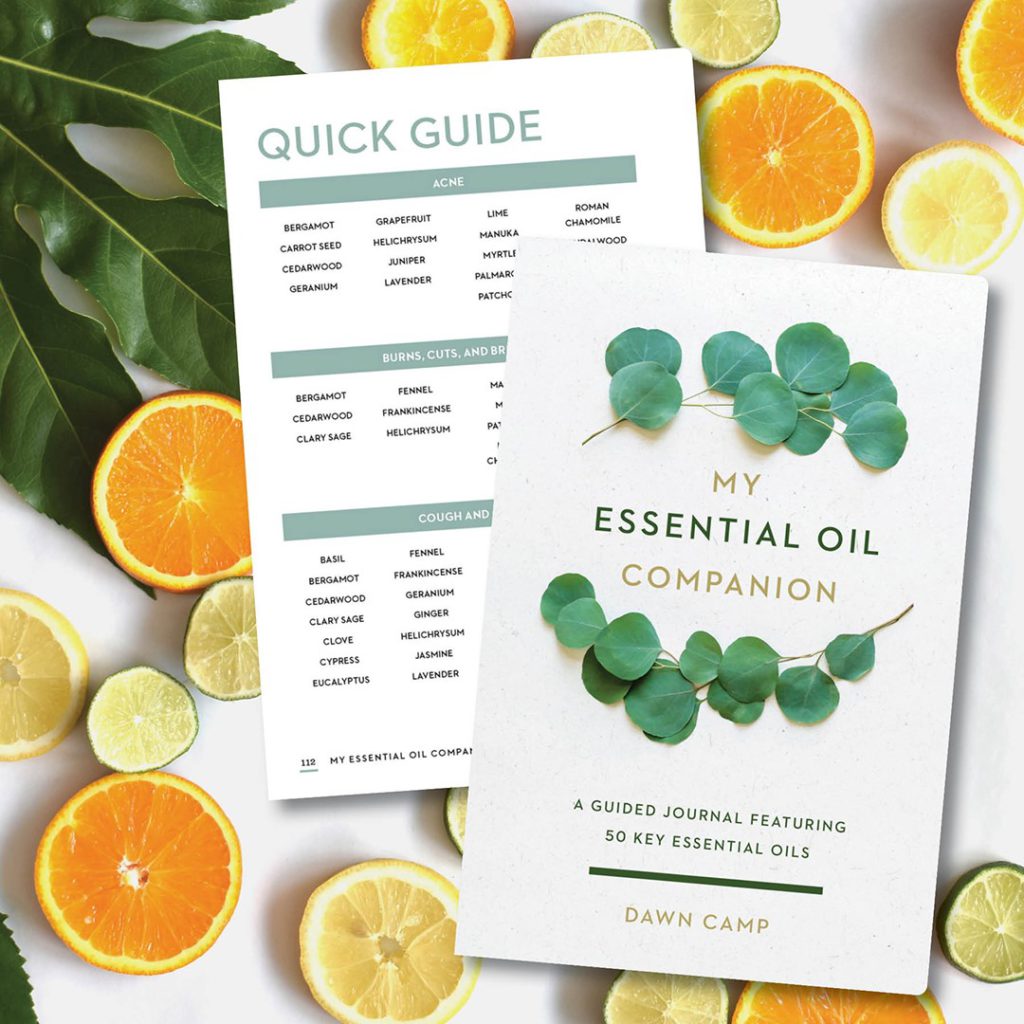
Maybe you’ve heard the buzz about essential oils, but you’re not entirely sure what they are or how to use them. Maybe you, like me, have more questions than answers and would benefit from a good instruction manual to help you. If so, I designed My Essential Oil Companion and It All Began in a Garden to fulfill that need for both beginners and experienced users. These books will not only inform you, they’ll point you straight back to God, the original herbalist, who created the plants themselves.

My Essential Oil Companion will expand your knowledge of fifty different essential oils and go deeper with journaling questions, tips, tricks, and testimonials, plus plenty of space for recording your personal notes. You’ll love the handy quick guide, which will help you find the best oils for a particular problem in an instant, and you’ll be awed by the user testimonials because God’s provision is so good!

I hope this book truly becomes your essential oil companion, helping you discover and document both the wonders and uses of God’s gift in nature!

So fun, right? Well, good news — we’re giving away FIVE copies*!
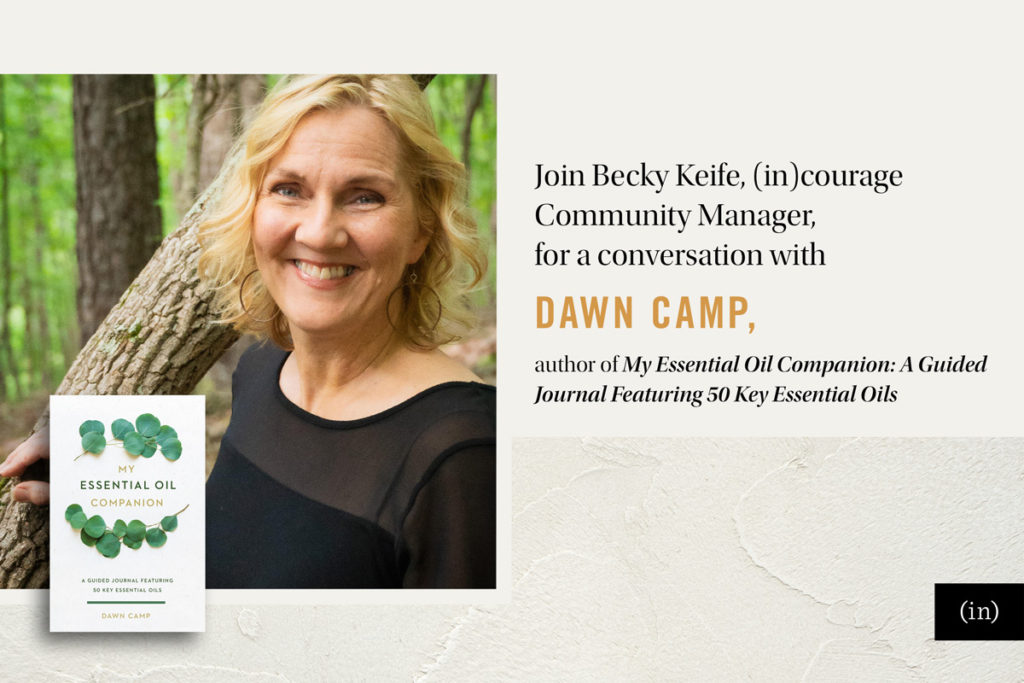
To enter, leave a comment on this article sharing your favorite way to use essential oils (or why you’d like to start using them), and we’ll choose five winners.

Also, tune in tomorrow, July 28th, at 10:00 am central, on Facebook for a conversation with author Dawn Camp and (in)courage Community Manager Becky Keife as they discuss My Essential Oil Companion.

*Giveaway open to U.S. addresses only and will close at 11:59 pm CST on July 30, 2021.

Filed Under: Books We Love, Encouragement Tagged With: essential oils, Recommended Reads

When Death Heals Your Fear of Death

July 26, 2021 by Rachel Marie Kang

Five months ago, I stood in my bathroom staring into a mirror stained with specks of toothpaste spit. I fixed my hair, pulling it behind my ears, and made my face up with all the chemicals, creams, and colors.

Then I took a brush to my son’s hair, long curls of auburn red, just like my own. I told him we were dressing up, even though we weren’t leaving the house, even though we were only going to turn the computer on and sit in our dining chairs to watch the virtual viewing of my grandfather who lost life to the faint pushing of breath in his lungs.

I still remember when I learned the news, how he had COVID, how it seeped into his body, lungs filling with fluid, heart heaving weaker and weaker with every faint breath.

When we lost him, I was eight months round and in the swell of pregnancy with my second son. When we lost him, the world was in the swell of a high wave of rising COVID cases. The nightmare of the worst year ending at Christmas and folding right into the New Year, loved ones losing life, left and right.

I watched the viewing as the wobbly camera captured my family speaking words of remembrance and sprinkling flowers atop my grandfather’s grave. I watched the snow on the burial grounds glisten as it lit up under the sun, reflecting right on through my computer screen. I could almost feel the chill of New York’s bitter air as much as I felt the warm tears rolling down my cheeks, crying muted into the camera while watching this virtual viewing.

The tears came because there was sorrow, but the tears also came because there was hope. As I sat there, cradling life in one hand and death in the other, I listened to the story of my grandfather’s last few moments, how he pointed to the ceiling of that hospital room and motioned to his three children that he was ready to be home, really home.

I sat there, tears branding themselves into my heart, and I couldn’t help but think about the little girl within me, and how she had always carried a fear of death because she  felt that it was close. Like the passing of her aunt when her heart gave out, the time the cancer took her grandmother away, or the annual memorial services for her grandfather, a Black police officer slain in the name of revolution — every year hearing the gunshots go out as men in kilt skirts played processionals on bagpipes. And how the little girl within me grew up seeing her brother fall to the floor in epileptic episodes, fearing that every bump in the house was the sound of her brother’s head banging on the ground and bleeding out.

But as I sat there, watching light ricochet off the frost-bitten ground, I did not feel a freeze seep into my breath or embitter my bones. I did not feel a sting, a burning anger, or that raging need-to-know of why and how. I did not see a body swallowed up by dirt and death. Instead, I saw hope rise as I reflected on the life of a man who had lived a life loyal to the love of Christ — a man who brought me up himself to know and trust the ways and words of God. Not a perfect man, but a professing man — a man who knew he needed God’s grace and who believed in the salvation that Jesus’ death offers.

I couldn’t help but think that if he could believe it right down to the moment of his passing, right down to the last breath, down to that moment when he motioned with his fingers that he knew where he was going and was ready to go, then so could I.

I know it doesn’t happen everyday that your grandfather, or some other beloved of yours, dies and inspires you to believe that death is not the end and that there is more to this life, but then I’m reminded that there was another Man whose death so many years ago brought more hope and healing into the world than it did hurt.

Jesus.

His death not only brought healing and hope for our lives here on earth, but it made healing and hope possible for every part of our hearts that longs to believe there is more to life. Jesus’ death, if we let it, gives us a healing truth and hope to hold onto, even while we cannot take on someone else’s pain or suffering or heart fading out, even though we cannot extend their time on earth, cannot keep the blood flowing, the heart beating, the lungs breathing. Even still, we can find hope in knowing that last gaping breath does not have to be the end.

In Christ, death is only the beginning. And we don’t need to fear that beginning because it will be the beautiful start to a breathtaking eternity with an ever-loving, everlasting God.

Filed Under: Courage Tagged With: death, grief, loss

  • « Go to Previous Page
  • Page 1
  • Interim pages omitted …
  • Page 101
  • Page 102
  • Page 103
  • Page 104
  • Page 105
  • Interim pages omitted …
  • Page 142
  • Go to Next Page »

Primary Sidebar

Receive daily devotions
in your inbox.
Thank You

Your first email is on the way.

* PLEASE ENTER A VALID EMAIL ADDRESS
  • Devotions
  • Meet
  • Library
  • Shop
©2025 DaySpring Cards Inc. All Rights Reserved.
Your Privacy ChoicesYour Privacy Choices •  Privacy Policy • CA Privacy Notice • Terms of Use