
Menu
  • Home
  • Daily Devotions
  • The Podcast
  • Meet (in)courage
    • Meet the Contributors
    • Meet the Staff
    • About Us
    • Our History
  • Library
    • The (in)courage Library
    • Bible Studies
    • Freebies!
  • Shop
  • Guest Submissions
  • DaySpring
  • Privacy
  • Skip to primary navigation
  • Skip to main content
  • Skip to primary sidebar
(in)courage - Logo (in)courage

(in)courage

Fix Your Eyes on Who He Is

Fix Your Eyes on Who He Is

October 26, 2025 by (in)courage 13 Comments

“Come, let us tell of the Lord’s greatness; let us exalt his name together.”
Psalm 34:3 NLT

When life feels heavy, our minds often rush to replay disappointments, dwell on what’s missing, or plead with God to fix what hurts. But what if, instead of beginning with our problems, we began with His person?

What if our first thoughts each morning weren’t about what’s wrong, but about who God is — steady, holy, faithful, kind?

When we meditate on God’s attributes, our perspective shifts. Worries shrink in the light of His greatness. Disappointments lose their sting when held up to His perfect wisdom. Our praise rises — not because our circumstances have changed — but because we’ve remembered the One who never does.

Choosing this posture doesn’t come naturally. Our flesh gravitates toward self-focus, but Scripture calls us to “fix our thoughts on what is true, and honorable, and right, and pure, and lovely, and admirable” (Philippians 4:8). Daily, intentionally turning our hearts toward God’s character is like reorienting a compass — we set our direction toward truth rather than feelings.

God is worthy of our worship — not merely because of what He does for us, but because of who He is. As we open our Bibles each day and praise Him for His attributes, we give Him the honor due His name. And in the process, our souls find rest.

Here are a few attributes to guide your meditation and praise:

  • God is Faithful — He always keeps His promises. His character never wavers. “The faithful love of the Lord never ends! His mercies never cease.” (Lamentations 3:22)

  • God is Sovereign — He reigns over all things with wisdom and power. “The Lord has made the heavens his throne; from there he rules over everything.” (Psalm 103:19)

  • God is Compassionate — He sees, understands, and draws near to the brokenhearted. “The Lord is like a father to his children, tender and compassionate to those who fear him.” (Psalm 103:13)

  • God is Holy — He is set apart, perfect in all His ways. “Holy, holy, holy is the Lord of Heaven’s Armies! The whole earth is filled with his glory!” (Isaiah 6:3)

  • God is Unchanging — He is the same yesterday, today, and forever. “I am the Lord, and I do not change.” (Malachi 3:6)

  • God is Good — His plans are for our ultimate good, even when we can’t see it. “Give thanks to the Lord, for he is good! His faithful love endures forever.” (Psalm 136:1)

You might choose one attribute each day this week. Read the related Scripture. Reflect on what it reveals about God’s heart. Speak it out loud in praise. Write it down. Thank Him — not just for what He’s done, but for who He is.

Over time, this daily rhythm of adoration becomes an anchor for your soul. Life will still have valleys and storms, but your heart will be steadied by the unchanging character of God.

Let’s Pray:
Father, You are worthy of all my praise. Forgive me for the ways I so often focus on my worries and wants before I fix my thoughts on You. Teach me to delight in who You are — to meditate on Your faithfulness, goodness, sovereignty, and love. Let Your character shape my perspective and fuel my worship. Today, I lift my eyes above my circumstances and give You the honor and glory due Your name. Amen.


Filed Under: Uncategorized Tagged With: attributes of God, Sunday Scripture, Uncategorized

If You Find Yourself In a Waiting Place

October 25, 2025 by Sabrian Enoch 29 Comments

At the end of spring, I planted zinnia seeds in several pots in my backyard. The packet promised blooms in 30-60 days, so I watered and waited. Weeks went by, then what felt like months. Nothing but weeds. I told myself the seeds must have been duds. And by mid-summer, I had written them off. I stopped checking the pots.

Then one morning, after the first cool breeze of fall, I walked outside to see bright, bold blooms bursting from the soil. Just when I thought the time window had passed, new life was just beginning. I carried a few inside and placed them in a vase on my kitchen counter. Every time I walked by, they preached a sermon I didn’t know I needed: God’s timing isn’t held bound by worldly promises.

Sometimes we assume if God was going to move, He would have already. We pray, we wait, and when the days stretch long, we quietly give in to disappointment. We think, Maybe it’s too late.

What if we let fall teach us otherwise? The leaves may be falling in surrender to the cooling air and shifting of seasons, but God can surprise us with blooms when we least expect it. What looks “past due” to us may be right on time according to God’s plan (Habakkuk 2:3).

When I clipped those zinnias, I realized how often I treat my own life like those seed packets. I expect God to move within my chosen time frame . . . and when He doesn’t, I assume the harvest is cancelled. Yet scripture reminds us not to grow weary, because in due season, we will reap a harvest if we do not give up (Galatians 6:9).

Maybe you’re carrying prayers that feel unanswered, dreams that still seem dormant, or hopes that you’ve buried long ago. Can I remind you of something? God is not bound by the timelines printed on our expectations. His seasons are set by His wisdom and sovereignty.

Yes, fall is a season of slowing down and letting go, but it’s also a season where God delights to surprise us with unexpected beauty. So, if you find yourself in a waiting place, don’t give up. Keep tending the soil of your faith.

Keep watering your trust in Him. One day, maybe when the air grows crisp and you’ve stopped looking for it, you may find a bloom bursting forth — proof that God was at work all along.

Filed Under: Guest Tagged With: fall, harvest, Patience, seasons, Trust, waiting

Kindness Like Healing Grace

October 24, 2025 by Dawn Camp 19 Comments

Someone close to me once asked me to share details about other people in a way that felt like gossip. Not only do I dislike gossip, but especially about these specific people. For me, participation was a hard no. Our tense, unsatisfactory conversation felt like a series of questions I kept having to dodge.

Later, this person told my mother, “Nothing I can say will make Dawn happy.” We were at an impasse. She didn’t see her questions as a problem. Instead, she thought I was being cold and evasive. As our relationship grew strained, I began to avoid her.

When I asked my wise mother for her advice, she said, “Kill her with kindness.” It restored and invigorated our troubled relationship beyond what I could have imagined, because that’s what happens when we’re tender-hearted. I learned a valuable lesson that I’ve never forgotten.

Our children have heard me say, “Be kind,” a million times. Now that we are raising three of our grandchildren, it’s become my mantra once again. Kindness does more than heal broken relationships; it comforts broken hearts.

Since our daughter’s death this summer, I’ve been on the receiving end of a humbling amount of kindness. I find myself in an uncomfortable place where my emotions sit just below the surface. It doesn’t take much to trigger them, and I’m terrible at hiding my feelings. Relative strangers, like the cashier at Costco and my new optometrist, have asked if it’s okay to hug me. I cry every time.

Small kindnesses are like healing grace.

The transition from summer to autumn is hitting me hard as I gather the necessary items for our grandchildren and discover boxes of carefully folded and neatly stacked clothing that our daughter prepared for them. These care packages, seemingly delivered through space and time from beyond the grave, labeled in my daughter’s handwriting, break my heart. She should be preparing her children for the upcoming season, not me. I often feel unprepared and struggle to be kind to myself.

A local foster care support organization supports families like ours. When I visited their donation center, they sent me home with coats, shoes, toys, and clothing, Halloween costumes, Christmas pajamas, robes, and house shoes for the children. The women there helped me find the correct sizes and piece together outfits. They dug through inventory that wasn’t yet on the floor, searching for items the kids might like. Before I arrived, they’d gathered toys based on their interests and packed a bag of party supplies for our grandson’s upcoming birthday.

Our family homeschooled for thirty years, but our grandchildren are enrolled in the local public school. Getting two sleepy children dressed, fed, and out the door —with their lunches packed and homework done and loaded into their backpacks each morning — is a challenge. The teachers and the support staff know who we are and are aware of the children’s unique situation, living with grandparents after the death of their mother. The staff have treated our family with such kindness, and we know they are well taken care of there.

If you listen to the news, you’ll only hear talk of division, but the conviction that you should do unto others as you would have them do unto you is alive and well. I have seen such goodness and grace over these past few months. Friends and neighbors have delivered meals and gift cards and offered to babysit. Strangers have donated clothes, toys, and school supplies.  

Radical kindness will transform your world for the better, and in most cases, it offers an immediate return on your investment. It diffuses animosity. It’s difficult to treat someone poorly when they’re treating you well.

We’re entering a time of year when we spend more time indoors among friends and extended family. People get stir-crazy, and tensions can flare. Let these two simple words — be kind — shape your thoughts and interactions.

The world will always have heartache and misunderstanding. But kindness — even the smallest act — has the power to shift the atmosphere. Whether it’s restoring a fractured relationship or holding space for someone’s grief, kindness breathes hope into weary souls. As the seasons change and the days grow colder, may we warm one another with compassion that reminds us we’re not alone.

People desperately need your kindness, like healing grace.


Listen to Dawn’s devotion here or on the (in)courage podcast.

Filed Under: Encouragement Tagged With: comfort, Community, Grace, grief, Healing, kindness, loss

How to Carry the Weight of Rejection

October 23, 2025 by (in)courage 3 Comments

I couldn’t stop crying. I didn’t think it would hurt this much. I thought I would be used to it by now, but this time the cut felt deep.

She was my friend. We had prayed together during difficult seasons and celebrated at our kids’ birthday parties. But when she decided to leave our church, she didn’t mention it to me. She unfollowed me on Instagram, unfriended me on Facebook, and unsubscribed from everything that connected me to her.

The reason she left had nothing to do with me, and she didn’t want to talk to me about it. But the message was loud and clear: I don’t want you or your church in my life. The weight of rejection slowly began to break me.

But I was the pastor’s wife, so I had to be strong and smile. I didn’t have a place to share my emotions and process the situation. I wanted to look unfazed because this type of rejection is part of ministry. People come and go all the time, but this felt different because the person was actually my friend. She didn’t just leave our church. She left me.

Sometimes people will just walk out with no warning and no resolution. It bothers me to have things left unresolved. We prefer if our conflicts can be wrapped up with a pretty bow, but sometimes there is no closure. When my friend wouldn’t have a conversation to close the chapter on our friendship, I felt a surge of anxiety. My mind raced through possible reasons she couldn’t talk — but I came up empty.

I went through a season of anger because I felt it was unfair. Then weeks of grief left me numb.

Come Sit with Me and Learn Together

We come into the world wanting to be held, loved, and seen. So when we feel rejected, we usually also feel alone and try to protect ourselves. This can lead to mistrust, avoiding vulnerability, and striving to win approval.

In the aftermath of my friend’s rejection, I began to put up my guard in every future relationship. I told myself that as a pastor’s wife, I should hold everyone at arm’s length and never again let anyone close enough to hurt me so deeply.

Immediately after I made this decision, the Holy Spirit impressed these words on my heart: “That is not the way I love you!”

I argued, “If I want to survive in ministry for the long haul, I have to protect myself from people hurting and leaving me.” Then He gently reminded me, “Simi, you hurt Me, you ignore Me, and you have rejected My voice, but I still love you the same. If you want to lead My people, you have to love them like I do — that is what it means to be a shepherd.”

I felt something shift, and I surrendered the pain to Jesus. I released my friend and my unforgiveness to God. That day, I decided to keep my heart soft and my people close. It may be difficult and I may get hurt again, but I will remain vulnerable enough to love God’s people. He will defend and protect my heart.

I decided I would not try to avoid rejection — that would require living as a hermit. Instead I would rest in the finished work of Christ who calls me accepted and approved. When rejection comes, I stand firm in the unchanging truth of God’s Word and continue living authentically without needing to prove my worth to others.

This experience helped me understand that relationships have seasons. People come and go. Our preferences change as we grow, so a person’s choice isn’t necessarily a reflection on us. What if we chose not to take it personally when friendships shift? Sometimes we bear the brunt of another’s unhappiness, but that doesn’t mean we’re the cause.

We have to allow the other person space to process instead of rushing to fix the issue. Relationships will always be risky, but that is true of everything worth our investment. God has called us to relationship with Him and others. God walks with me. I lean on Him for wisdom on how to set boundaries, when to be vulnerable, and how to forgive.

Maybe for you it’s a family member who left, a friend who ghosted you, or a boss who overlooked you. Whatever the source of the rejection, the pain is real. Sometimes there is no solution, but you still have a choice in how you respond.

Paul writes, “Live in harmony with each other… Do all that you can to live in peace with everyone” (Romans 12:16–18 NLT).

While we are responsible for our actions, we aren’t responsible for how others respond. You can behave honorably even when someone treats you unfairly. You may do all you can to live in peace, but they still may not desire a relationship with you. You might not have closure, but you can have internal peace.

Even Jesus was rejected. Many times in the Gospels, we see Him walking away in silence, and He teaches His disciples to “shake off the dust from your feet” when faced with rejection (Matthew 10:14 ESV). To live at peace with those who have rejected us, we have to learn to shake it off.

Friend, if you are hurting today, if you are feeling the sting of rejection or the pain of a broken relationship, be assured of this: God sees you, and He is working through you.

Written by Simi John, adapted from (in)courage’s popular book, Come Sit with Me. Grab your copy for deep encouragement from your favorite (in)courage writers as we learn together How to Delight in Differences, Love through Disagreements, and Live with Discomfort.

Filed Under: (in)courage Library Tagged With: (in)courage library, church, Come Sit With Me, friendship, rejection

You Were Not Designed to Stand Alone

October 22, 2025 by Dorina Lazo Gilmore-Young 20 Comments

The nurse handed me the iridescent pink reusable bag and let me know I could put my clothes inside when I changed. She handed me a folded hospital gown and pointed out the dressing rooms along the south wall. 

My hands trembled a bit as I took off my clothes and put on the gown with the opening to the front as instructed. The fabric was thin with flimsy ties. This simple gown couldn’t possibly cover my parts or hold me in the way I felt like I needed right then. 

I made my way to the waiting area. Only five chairs for a host of women being ushered in and out of the mammography rooms. I chose a spot near the bathroom door – a bit removed from the other women – so they didn’t have to listen to my four square breathing while I waited for them to call me back for my biopsy. These appointments hold a gravity for me, especially after my first husband died of cancer.

My eyes scanned the room, noting the diversity. Women of different sizes, shapes and skin tones filled the space. Eavesdropping was not optional in this small area. Two women sitting on the other side were having a conversation. The older woman with curly, salt and pepper hair unraveled some of her story. She talked about her diagnosis and how she had shaved her head before the first round of chemo because she didn’t want to witness it falling out. 

I couldn’t see the other woman’s face but she was closer to my age. She responded with affirmations, honoring the woman’s experience while the rest of us listened. I remember thinking how beautiful and composed the seasoned woman was. There was a certain levity in her storytelling that helped us all breathe. 

Something about their exchange lifted my spirit from the anxiety that threatened to spill over. As they related, we all nodded our understanding and encouragement. 

The older woman rose suddenly and headed toward me. I wanted to hug her, but refrained. She swung open the door to the single user bathroom. We locked eyes.

“These appointments make me so nervous,” she said under her breath.

“I hear you,” I said. 

I wanted so badly for her to know that she wasn’t alone. Almost as badly as I wanted someone to tell me I was not solo sitting there with only thin hospital gown fabric shielding my middle-aged body.

In the book of Ecclesiastes, there is a passage that gives us a vision of the power of community. In a time when there is so much tension, violence, and division pervading our communities, I cling to these words of wisdom: 

“Two people are better off than one, for they can help each other succeed. If one person falls, the other can reach out and help. But someone who falls alone is in real trouble. Likewise, two people lying close together can keep each other warm. But how can one be warm alone? A person standing alone can be attacked and defeated, but two can stand back-to-back and conquer. Three are even better, for a triple-braided cord is not easily broken.”
Ecclesiastes 4:9-12 NLT

These truths remind us we are stronger when we pivot away from scarcity and support each other. This passage paints a picture of the strength we gain when we defend and protect each other, when we call each other out and build each other up. 

I received a message from a friend the other day that simply said: “I’m always here if you need someone to process with.” Tears sprung to my eyes. That simple text message made all the difference in lifting me up in challenging circumstances. She helped me feel like I was not alone.

Friends, the point is we need each other. These days are challenging, full of unexpected turns on the trail and hills that are steeper than we might anticipate. I have discovered the way to persevere and flourish is in community. 

After all, God’s heart beats for community. He Himself embodies community. He is Father, Son, and Holy Spirit – three in one like that triple-braided cord – our model of community working seamlessly. He designed us to live in relationships, to work out our insecurities and use our gifts in the context of community. We are to bear each other’s burdens and lighten each other’s load (Galatians 6:2).

All throughout Scripture we find examples of women who moved courageously in community:

In an act of civil disobedience, Hebrew midwives Shiphrah and Puah honored God and disobeyed Pharaoh’s orders to kill Israelite baby boys, saving many lives. 

A sister squad, who were the daughters of the late Zelophehad, banded together and bravely asked Moses to consider their predicament. God awarded them property in the Promised Land because of their respectful request.

Two widows, Ruth and Naomi, immigrated to a new land and navigated grief together – eventually taking their place as bold branches in Jesus’ family tree. 

Elizabeth and Mary stayed together and encouraged each other through unexpected pregnancies before the births of their sons, John and Jesus. 

Sisters Mary and Martha joined other women, including Joanna, Mary Magdalene, Salome and Susanna, serving in Jesus’ ministry. These women walked, prayed, cooked, provided resources and followed Jesus to the cross. They were among the first to witness His resurrection and share the Good News with others. 

The nurse called my name. I gripped my bag and shuffled into the little room where a technician appeared. Her bright smile welcomed me. She explained the procedure they would do. First an ultrasound, and then a biopsy to check on something that could be suspicious from my mammogram.

After the ultrasound, the radiologist examined the screen. She spoke words I didn’t anticipate. “Were you excited about getting a biopsy today?” she asked with a hint of humor.

I thought it was a trick question. No, I wasn’t excited about getting a biopsy. 

“Well, you don’t need one,” she smiled. “Whatever they saw during your mammogram a few weeks ago is completely gone.”

I exhaled.

I left the office and slipped through the waiting room, smiling at my sister-friends in their hospital gowns and offering up a prayer for each of them. It felt like I had been given a miraculous gift – not just a clear health report, but also a profound experience of courageous community.

Dorina helps people feast on the glory of God through her weekly Glorygram on Substack and her new Bible study, Redeemer: God’s Lovingkindness in the Book of Ruth.


Filed Under: Encouragement Tagged With: Aging, Better Together, Community, courage, health, Scripture, women

I Didn’t Know!: The Story Behind Jesus’s Birth

October 21, 2025 by (in)courage 81 Comments

“Now in those days a decree went out from Caesar Augustus, that a census be taken of all the inhabited earth. This was the first census taken while Quirinius was governor of Syria. And everyone was on his way to register for the census, each to his own city. Joseph also went up from Galilee, from the city of Nazareth, to Judea, to the city of David which is called Bethlehem, because he was of the house and family of David, in order to register along with Mary, who was engaged to him, and was with child. While they were there, the days were completed for her to give birth. And she gave birth to her firstborn son; and she wrapped Him in cloths, and laid Him in a manger, because there was no room for them in the inn.”  
Luke 2:1–7 NASB 

Every Christmas, Christians focus on the birth of Jesus. The beautiful stories of Matthew and Luke are reenacted. To appreciate fully this wonderful story, it is necessary to know something of the historical backdrop and context. The birth of Jesus didn’t simply “come out of the blue.”  

Life was difficult for the Jewish people at the time of Jesus’s birth. The hated and paranoid King Herod was near the end of his life. Would-be kings were recruiting followers, hoping to overthrow Rome and win freedom for Israel. Some didn’t want change; they liked the way things were.  

Although not all Jews in the first century expected a Messiah, many did. They believed that Isaiah’s beautiful prophecy would someday be fulfilled: “For a child will be born to us, a son will be given to us; and the government will rest on His shoulders; And His name will be called Wonderful Counselor, Mighty God, Eternal Father, Prince of Peace” (Isaiah 9:6).  

Those who clung to this reassuring prophecy assumed it would be fulfilled in some grand fashion. Surely this promised son — this descendant of David, Israel’s greatest king — would come in glory and power, or so many assumed. But not so; He was born to humble parents, and He spent His first night in a feeding trough!  

Let’s take a closer look at the beloved yet often misrepresented Nativity scene. It is true that the King James Version, as well as the New American Standard Bible, which is quoted above, says that there was “no room for” Joseph and Mary “in the inn,” but the Greek is better translated “guest room.” Mary and Joseph had likely gone to the home of friends or relatives, but their guest room (probably upstairs) already had another family in it. This is why Joseph and Mary were given the stable below (or beside) the house. But the stable is not outside in a barn; it is part of the house, downstairs, kind of like a modern garage. Mary and Joseph were afforded privacy, but we should assume that when Mary gave birth, she was assisted by family and friends.  

Archaeology has uncovered the remains of the floors and foundations of some of these homes with connected stables. Archaeologists have also recovered mangers, or feeding troughs, which almost always were made of stone. The birth of Jesus and the first few days of his young life may have unfolded in a rustic setting, with animals nearby, but it was not in a dirty barn. And while we usually picture the three wise men visiting the infant Jesus, they didn’t arrive until one or two years later.  

The evangelist Matthew caught the significance of the birth of Jesus when he noted that it fulfilled yet another prophecy of Isaiah: “Behold, a virgin will be with child and bear a son, and she will call His name Immanuel,” or “God-with-us” (Isaiah 7:14). In the birth of Jesus and in the fulfillment of this important prophecy, it would soon become clear that God was indeed with us, to save us from our sins (Matthew 1:21).  

God often chooses to use the least likely, the small, or the weak for His redemptive purposes. Here, the salvation of the world is seen in the birth of a child from a humble family, not from an influential family or in the arrival of a powerful army. When Mary was told of her unexpected pregnancy, she responded, “May it be done to me according to your word” (Luke 1:38).  

She believed that the God of Israel could accomplish His purposes in her, a young woman of no power or influence. God can use us ordinary people for His purposes too. He has done it many times before, and He is still doing it today!

When you think of popular Bible stories, like the Christmas story, you might imagine particular things — that Mary and Joseph were poor, that they traveled through the desert to get to Bethlehem, or even that Jesus was born in a dirty barn. But are those things really true?

Sometimes we approach Scripture with Western eyes and English translations that don’t give us a complete picture of the historical and cultural reality of these stories.

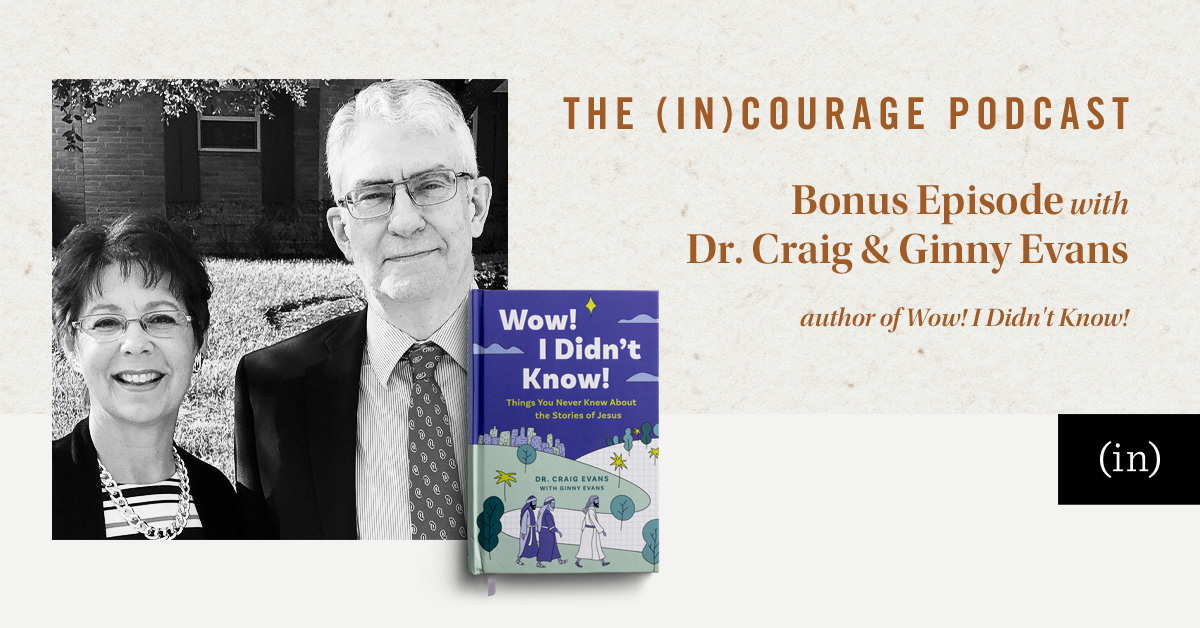
The new book, Wow! I Didn’t Know!: Things You Never Knew About the Stories of Jesus by Dr. Craig & Ginny Evans, dives deeper into Scripture to shine a light on common misconceptions and reveal the more likely facts that can not only deepen our understanding, but change the way we view the stories that many of us know by heart – not only the Christmas story, but many from Scripture. 

We know you’ll be so encouraged and inspired by this new book. . . so we’re giving away FIVE copies*! Just leave a comment on this article, and we’ll select five winners at random.

Then tune in over the weekend to the (in)courage podcast for a conversation with Becky Keife and Dr. Craig & Ginny Evans as they discuss this unique book! You don’t want to miss the stories, wisdom, and encouragement they share!

About the Authors: Professor Craig A. Evans is a well-known New Testament scholar, prolific author, popular teacher, and sought-after speaker. He has taught in North America and around the world, published more than 90 books, authored more than 700 academic and popular publications, and has consulted for the National Geographic Society, the Museum of the Bible, and many others. He is best known for his contribution to work on the Gospels, historical Jesus, the Dead Sea Scrolls, and archaeology of the New Testament.

Ginny Evans holds degrees in home economics and library science and has actively supported and managed her husband’s ministry for over 50 years. As an amateur genealogist, she has authored a dozen books of memoir and family history. Ginny and Craig have two daughters and two grandsons. After living for 35 years in Canada, they now make their home near Houston, Texas.

*Giveaway open to US addresses only, and closes on 10/26/2025 at 11:59 pm Central.

Filed Under: Books We Love Tagged With: Books We Love, DaySpring, Scripture

The Year I Learned What Women Want

October 20, 2025 by Laura Kelly Fanucci 8 Comments

When I was 22, I spent a year in France. Far from the glamour of Parisian cafes, I worked in a L’Arche home for adults with disabilities and in a Baptist homeless shelter for women and children. One of my volunteer assignments in the shelter was coordinating enrichment activities for the residents. I organized outings to parks, theatres, concerts, and museums — all offered free of charge by local municipalities, a healthy and holistic approach to homelessness.

One Saturday morning during a trip to the city swimming pool, I started chatting with Jan, a recently arrived refugee who had fled with her fiancé from North Africa in the hopes of finding a better life together in France. Both of them were highly educated and successful professionals in their homeland, but in a new country where they encountered red tape and racism at every turn, they were now struggling to make ends meet with low-paying jobs.

Still, the dream of freedom and opportunity sparkled in Jan’s eyes, even though her fiancé was now living in the men’s shelter and their plans for marriage were on hold for the time being. As we sat on the pool steps and watched children splashing, I offered to help her practice speaking English. She jumped at the chance to do the same for me with my French. Turns out we both needed each other.

A few weeks later, Jan introduced me to Sylvie, the mom of two adorable wild-haired kids who were new residents of the shelter. Sylvie was stressed and high-strung, understandable as she had just left an abusive marriage. She often snapped at her kids before meals when hunger ran high and patience ran short. But I always saw her apologize to them and ask their forgiveness, cuddling them both onto her lap while everyone waited for dinner to be served.

One day before lunch, I taught Sylvie’s kids how to say “yes” in English, and they spent the meal in peals of laughter, using their new word. “Yes” to the salad course, “yes” to the main course, “yes” to the cheese course, and dessert! For all the soup kitchens I knew back home, where meals were pieced together from disparate donations, I was amazed to see how the hungry were fed in France. A delicious, healthy, wholesome meal with multiple courses was offered in every home and school — why wouldn’t the same be true in a homeless shelter?

As months rolled on, I came to know the rhythm of life in the shelter. Meals together, work hours apart, excursions or exercise in the evenings. We sang, danced, and feasted. We also grumbled, disagreed, and disappointed each other. In short, we were human together.

But the most important truth I learned from the women I met was that we want the same things, all over the world. We want to be seen, known, and loved. We want to be safe, respected, and nurtured. We want to care for ourselves, our families, and our community.

We want to help each other survive and thrive.

In my early years of motherhood, I often thought back to the women in the shelter. When I was sleep-deprived, I pictured Jan and her fiancé, fiercely determined to keep working and clinging together. When my temper roared, I remembered Sylvie’s flare-ups — but also her forgiveness. Whenever I sat down to lunch at my table full of hungry, cranky kids, I remembered there was always enough time to pray and feast together — even if we only sang “Johnny Appleseed” over chicken nuggets and apple slices.

The women in France taught me the truth held in the story of Ruth and Naomi. Overwhelmed by loss and clouded by grief, Naomi despairs of any hope. Yet Ruth stands firm in faith, speaking words of commitment that have echoed through the centuries:

“Where you go, I will go;
where you lodge, I will lodge;
your people shall be my people,
and your God my God.”
Ruth 1:16 NRSVUE

Clinging together does not fix what has broken. Naomi is still bitter after Ruth promises her vow. Both women are still grieving for their husbands and everything they once knew. But their solidarity becomes the solid foundation for a new life together.

When I look at all that is broken, unjust, and evil in our world, Ruth’s words lift my head, too.

We must cling together as compassion-bearers. We are called to care for one another as caregivers. The bond between women of faith can remake the world around us, just as Naomi and Ruth forged a new future together. We belong to each other, as women of the same world and women of the same God.

Countries, marriages, careers, societies — they rise and fall. The women I met in the shelter turned out to be so similar to my friends and family back home. The lessons I learned from them stretched far beyond French slang or cultural etiquette. They taught me that wherever I go, I will find women of fierce faith and surprising strength. All of us hoping, dreaming, and working for a better world.

Whatever happens, we go together. Wherever we go, we are women with God.

For more of Laura’s writing, read her essays on finding God in daily life at The Holy Labor or follow her reflections on surviving cancer at The Compassion Brigade.


Filed Under: Encouragement Tagged With: belonging, Community, faith, global, homeless, travel, women

In the Waiting, He Is Working

October 19, 2025 by (in)courage 17 Comments

“Let us hold tightly without wavering to the hope we affirm, for God can be trusted to keep his promise.” Hebrews 10:23 NLT

There’s something about the shift of seasons that invites us to pause. The air cools. The light softens. Trees release what they no longer need. In the quiet turning of fall, God gives us a gentle reminder: change is part of His design.

Maybe you’re walking into this season carrying more questions than answers. Perhaps you’re praying for breakthrough and the silence feels heavy. Maybe you’re holding joy in one hand and heartache in the other. Or you’re faithfully putting one foot in front of the other even as worry tries to creep in.

Wherever you find yourself, here’s the good news: our hope isn’t anchored to our circumstances — it’s anchored to Christ. His promises don’t wither with the leaves. His faithfulness doesn’t fade when the days grow shorter.

The trees don’t fight the changing season; they trust the One who brings spring again. In the same way, we can release our grip on control and cling instead to the One who holds all things together. Waiting on God is not wasted time. It’s the sacred space where faith grows roots.

So as this new season unfolds, lift your eyes. God has not forgotten you. His timing is sure. His presence is near. And even now, He is weaving your story into something beautiful for His glory.

Prayer:
Lord, thank You for being faithful through every season. Teach me to trust You in the waiting, to rest in Your promises, and to keep my eyes fixed on You. Let hope rise in my heart as I remember that You are near and at work, even when I can’t see it. In Jesus’ name, amen.

Filed Under: Uncategorized Tagged With: fall, prayer, seasons, Sunday Scripture, Uncategorized

Harvesttime + a Recipe for Pecan Pumpkin Bread

October 18, 2025 by (in)courage 5 Comments

“God revealed Himself by doing good to you — giving you rain for your crops and fruitful harvests season after season, filling your stomachs with food and your hearts with joy.”
Acts 14:17 The Voice

The harvest season is a time of anticipation. Farmers gather their crops in hopes of a good yield, reaping the growth of all the planting done in earlier seasons. And for gardeners, it’s a time for gathering the overflow of fruits and vegetables from what was planted. Reaping happens every fall at harvesttime. We even see it in nature as squirrels and other animals scurry around, collecting nuts and seeds to store in the ground for the colder months ahead. This time of harvest shows us how God always supplies us with what we need. It’s a rhythm that happens every year, and it’s part of God’s design, plan, and purpose for the fall season.

“As long as the world exists, there will be a time for planting and a time for harvest. There will always be cold and heat, summer and winter, day and night” (Genesis 8:22 GNT). Every year, we know a time of harvest will come — just as we know there will be the cold of winter and the heat of summer. We can count on the supply of the harvest because God is always faithful to bring it. This rhythm in nature is as unchanging as God and His love for us.

Just as the harvest teaches us about God’s faithfulness, we can also learn about God’s perfect timing from the farmer. James 5:7 (TLB) says, “Be patient, like a farmer who waits until the autumn for his precious harvest to ripen.” When a farmer cares for his fields of crops, he patiently waits as they grow, trusting that they will ripen for harvest at the right time.

In a similar way, we need to patiently wait on the God who cares for us, trusting that as we wait on Him to work in our lives, He will give us a “harvest” of answered prayer at exactly the right time. It’s important for us to be patient in waiting on God and to trust in His timing and wisdom as He guides and directs us. Only He can see the big picture, and He sees things we cannot see. He wants to bless our lives with abundance and fill our hearts with joy. He wants the very best for us. If He doesn’t answer a prayer in the way we hope, it’s because He is answering it in a better way.

Sometimes it may seem like God is delaying answering our prayers, but we can trust that He always gives us what we need when we need it. His timing is not our timing — it’s so much better!

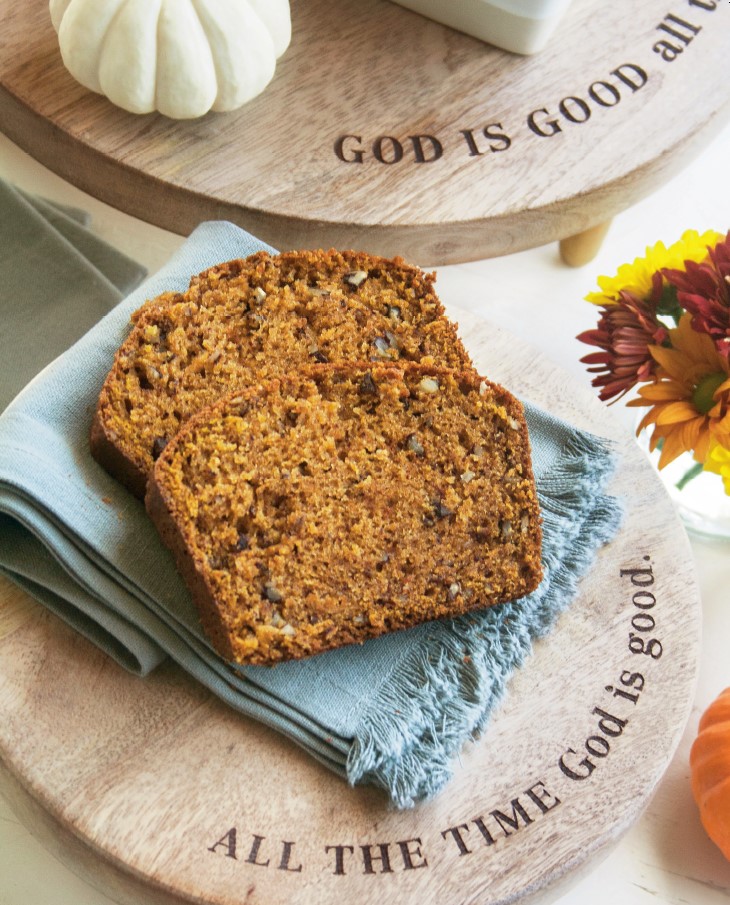
As you enjoy this harvest season, maybe you’ll have some time to make Pumpkin-Pecan Bread. The fall season just isn’t the same without it! Think about the abundant ways God has blessed you this season as you mix the pumpkin puree, cinnamon, and other good things into the batter. And thank Him in advance for how He is working to fill the needs you are praying about right now. You can rest in His promise in Philippians 4:19 that He will provide all you need.

Lord, You are a God of abundance, and we are so grateful for how You provide for us in every way. Your supply of love, care, and provision never run out. You even know what we need before we ask and are always so faithful to watch over us, guide us, and protect us. We thank You for the beauty and the bounty of the harvest season and the lessons You teach us from it. Give us the patience and trust we need to stay strong in our faith as we wait on You to work out Your good plans in our lives. Remind us that Your ways are always best for us. And Father, let us find peace and rest in knowing that we can give all our needs and cares to You, and You will provide for us in Your perfect timing, exactly when we need it. We love You and are so grateful for Your amazing love for us. Amen.

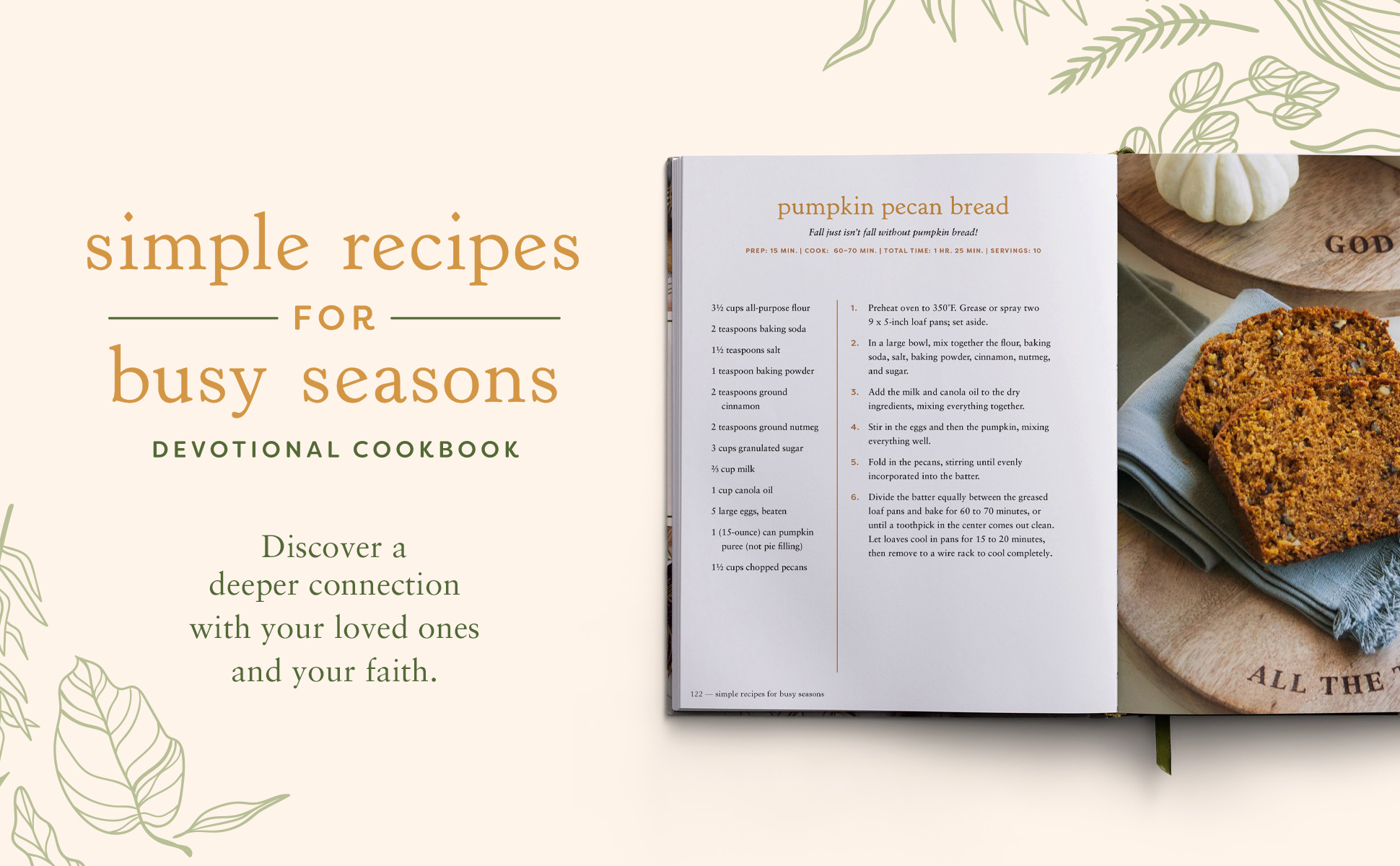
Pecan Pumpkin Bread

PREP: 15 MIN. | COOK: 60–70 MIN. | TOTAL TIME: 1 HR. 25 MIN. | SERVINGS: 10

Ingredients:

  • 3 1/2 cups all-purpose flour
  • 2 teaspoons baking soda
  • 1 1/2 teaspoons salt
  • 1 teaspoon baking powder
  • 2 teaspoons ground cinnamon
  • 2 teaspoons ground nutmeg
  • 3 cups granulated sugar
  • 2/3 cup milk
  • 1 cup canola oil
  • 5 large eggs, beaten
  • 1 (15-ounce) can pumpkin puree (not pie filling)
  • 1 1/2 cups chopped pecans

Ingredients:

  1. Preheat oven to 350˚F. Grease or spray two 9 x 5-inch loaf pans; set aside.
  2. In a large bowl, mix together the flour, baking soda, salt, baking powder, cinnamon, nutmeg, and sugar.
  3. Add the milk and canola oil to the dry ingredients, mixing everything together.
  4. Stir in the eggs and then the pumpkin, mixing everything well.
  5. Fold in the pecans, stirring until evenly incorporated into the batter.
  6. Divide the batter equally between the greased loaf pans and bake for 60 to 70 minutes, or until a toothpick in the center comes out clean. Let loaves cool in pans for 15 to 20 minutes, then remove to a wire rack to cool completely.

The Simple Recipes for Busy Seasons Devotional Cookbook is designed for hectic moments, offering heartfelt devotions that encourage you to breathe, pause, and find peace in God’s presence, alongside quick, wholesome recipes that bring your family together without adding to your stress. Find many more recipes and devotions like the one above in Simple Recipes for Busy Seasons!


Filed Under: Recipe Tagged With: Books We Love, recipe, recipes

Why Does Truth Seem So Hard to Find?

October 17, 2025 by Tyra Rains 10 Comments

A couple of nights ago, my husband Darian and I had two of our six grandkids with us. As we prepared to head home for the night, I opened the door to our SUV and got our grandson situated while he buckled himself in. Darian was on the other side of the car, helping our granddaughter. From the moment we both closed the back doors to the moment we opened ours, something had transpired in that back seat — something that left our youngest in tears.

Her brother immediately stretched out his hand and said, “See, my hand can’t even reach her.” Of course, he had hit her—and we all knew it. Now it was just a matter of uncovering the truth. Through a series of questions, we found out that he had indeed hit her… because she was talking to him, and he didn’t want her to.

There’s a Scripture in Proverbs that says, “He who tells his story first makes people think he is right, until the other comes to test him” (Proverbs 18:17 NLV). The Bible is so wise. It’s as if the Lord knew we’d be inundated with misinformation. That’s why we must rely on the Holy Spirit. He will lead us into all truth (John 16:13) — but we have to be willing to hear it. After all, Jesus said we would know the truth and that the truth is what would set us free (John 8:32).

I believe we all want to be free. Free from bitterness, doubt, insecurities, sickness, anxiety, anger, poverty, fear… the list goes on and on. The things that try to bind us up are never-ending. To be set free from the things that have bound us, all we need is truth. 

The other day, I was talking to a friend who asked me to look into something I didn’t agree with. I love that friend, so I did. I researched, fact-checked, and prayed. I asked the Lord to show me the truth. That’s a prayer many people don’t want to pray — and most aren’t willing to do.

Darian and I were discussing this recently. People often describe themselves as desperate to hear from the Lord. Our suggestion? Go to a quiet place and ask the Lord what He wants to talk about. Don’t approach Him with a pre-decided agenda. Be willing to hear “yes” or “no.”

We’ve found that, more often than not, people aren’t even willing to ask God if they’re wrong. “Am I wrong, Lord?” Those four words are a humble place to be. Humility is the posture closest to the Lord’s heart. Grace is found there. In that posture, the voice of the Lord becomes easier to hear.

Scripture tells us that the Lord opposes the proud. So how can we hear Him when we’re in a heart condition He’s actively opposing? Pride is the mindset that says, “I’m right. I’m always right. Nothing you say can change my mind.” In our family, we often say, “Statistically speaking, there’s no way we’re right 100 percent of the time.” It’s a funny statement we laugh about — but it’s true.

It’s also true that many times what we believe could be a lie. Maybe it was the first thing we heard, so we assumed it was true. Maybe it came from a source we love. My grandson lied about hitting his sister, and I could’ve just believed him because I love him. But instead, I investigated further — and found the truth.

The truth is what we want. The truth is what sets us free. Truth is truth—and just because someone says it isn’t doesn’t make it untrue.

Let’s put our pride aside and genuinely ask the Holy Spirit to lead us into all truth. Even in the things we are passionate about. This world is full of lies that keep people bound in hatred, insecurity, anxiety, and rage. We are in this world, but as Christ-followers, we are not of it.

Let’s be willing to be corrected by the Lord. Let’s be willing to admit we don’t have every answer. Let’s humble ourselves and go to the One who does. And when we find the truth — let’s embrace it.

Truth cannot be changed. And when we walk in truth, it brings great joy to our Father in Heaven. He said in 3 John 1:4 (NIV) “I have no greater joy than to hear that my children are walking in the truth.” Could it be that it brings great joy to our Father because it sets us free? Let’s search for Truth today and ultimately find the freedom that comes with it. 


Listen to Tyra’s devotion here or wherever you listen to podcasts.

Filed Under: Encouragement Tagged With: culture, faith, hearing God's voice, Honesty, Humility, prayer, truth

Give Us This Day, Some Evidence of Light

October 16, 2025 by Tasha Jun 28 Comments

I was in a rush that afternoon. The grocery store parking lot was full. I rehearsed what we needed: taco shells, cilantro, and creamer, while thinking about the news headlines I’d read just hours before. The daily circus of horrible news hung over my mind like a blanket.

I couldn’t shake this thought: everyone everywhere hates each other.

I had read about terrible things being said and done to other human beings — those created in the image of God. I thought about the repercussions of cruelty and hate and how they keep reaching further and deeper as one generation stacks upon another. Along with the heaviness of the headlines that day, I had left the house discouraged over an automated response email from one of the representatives I’d emailed about an issue close to my heart. I wondered where and how the light would shine through.

I started to recite The Lord’s Prayer in my mind, trying to refocus and remember how Jesus taught His disciples to pray. Our Father in heaven, may your name be kept holy.*

I thought about the world the disciples lived in, the cultural moment and customs that made up their everyday lives, and how they, too, must’ve longed for any evidence of light at the end of the tunnel, for evidence of goodness at work despite all the bad, hard, and confusing things, and for hope to not wane day after day. May your Kingdom come soon.*

As I walked from my car to the entrance of the store, I saw a group of people circled in front of an elderly man in the parking lot. They were bent over, looking at small shiny objects on the hot pavement. May your will be done on earth, as it is in heaven.*

The elderly man stood there, silent, but his body spoke. His hands were shaking. He held a plastic grocery bag that rustled with his shaky hands, and his mouth was slightly open while he watched the people around him. Give us today the food we need.*

As I got closer, I realized none of these people knew each other. The shiny objects were coins and they were scattered near and far. They were working together to pick up the coins.

Once I was close enough, I asked, “What happened?”

A woman who had stopped her van in the middle of the parking lot grabbed a sturdier bag and gave it to the elderly man to use, and said, “Here, this might hold the coins better than that Kroger bag.” She turned towards me and said, “He dropped all of his money on the ground.”

I pushed my crossbody purse from front to back and got into a kimchi-squat. The woman bent down next to me, nodded at me in solidarity. There were at least six of us there, not including the man who dropped his coins. We ranged in age from teenagers to senior citizens. Our skin color was varied. From the t-shirt one of the men was wearing to the music playing from another woman’s idling car, I could tell this group of people probably didn’t spend time around the likes of one another.

I thought about what else might get a group like ours that day in as close of quarters as we were in this moment. This group of strangers, but neighbors as Jesus would’ve called us to be to one another. I thought about the news headlines I saw just before this unexpected moment, and how I wanted to throw my phone on the ground over what I read. I had left for the store wanting to give up. On the drive I felt angry towards those I was sure lacked the love and empathy of Jesus. And forgive us our sins, as we have forgiven those who sin against us.*

We worked quickly to gather this man’s lost coins. We reached under parked cars, all of our arms and hands working in tandem. That day, we momentarily stopped our plans because this man needed something we could all come together to provide. I’m not sure he could’ve easily bent over to pick up his coins, and if he had, I’m sure he would’ve struggled to get back up. He never uttered a word while we gathered on his behalf, but he didn’t need to.

We smiled and nodded at one another as we collected dimes, nickels, and pennies, until there were no more left on the ground. Once we were done, we dusted our hands off and sent the man on his way with a new bag. One of the men gently patted him on the back before we all dispersed and carried on with our individual lives. And don’t let us yield to temptation, but rescue us from the evil one.*

I went back to rehearsing my short list of groceries as I walked into the store and found a cart, and then started to cry. I’d just experienced a simple, ordinary moment without a big stage, but it was sacred. For me, it was a living sermon without words, but full of hope. It was the daily bread of life that my spirit needed. May it be so, again and again, Amen.*

*excerpts of The Lord’s Prayer woven throughout the article are from Matthew 6:5-15 in the NLT


Listen to Tasha’s devotion here or on the (in)courage podcast.


Filed Under: Encouragement Tagged With: Community, faith, hope, kindness, Lord's prayer

A Three-Sentence Prayer That Helps When I’m Worrying

October 15, 2025 by Holley Gerth 14 Comments

I’m driving on a beautiful afternoon, the leaves just beginning to turn gold, orange, and crimson. I have my favorite playlist on, snacks in my bag, and a weekend away with friends to anticipate.

But my thoughts are in the past, circling an old situation like my car is stuck in a roundabout. I keep trying to exit by rewriting the ending of the story so that it will turn out the way I hoped, but I can’t change anything.

At breakfast with a dear friend last week, she shared that she felt the same way about a situation in her life. I asked her, “Why do we keep coming up with all of these alternate endings if we know they won’t ever happen?”

She paused for a moment and said, “Because we want to control. We want there to be something we can do about it.” She and I are both the action-taking type, and if there’s a way to fix something, then we are going for it.

I nodded my head in agreement with her words and said, “What we want is control, but what we really need is surrender.” I liked the way that sounded as I spoke it, but the reality of those words is not shiny or easy. Surrender is one the hardest things we do as humans.

As I drove, I thought about that conversation, then I paused and whispered a three-sentence prayer that helps when I’m worrying, “God, I release control and choose surrender. I give everyone and everything to you, especially this situation. What do you want me to say to myself when this comes to mind again?”

It seemed the quiet whisper I heard within my heart was this…

They were never yours to save.

Those words didn’t replace the grief of what happened with this person, but my soul did breathe a sigh of relief. I’d been telling myself that if I could have said the right thing, done the right thing, tried harder, loved better, then I could have made everything okay.

But there is only One who can save any of us, and it is okay to release those we love to Him. This doesn’t mean that we don’t care, that we don’t do everything we can, but it does mean that ultimately the outcome isn’t in our hands.

If you’re looking back at a situation, especially with someone you love, that you wish you could change, then I hope what my heart heard is a gentle release, a compassionate invitation for you too.

The God who spoke the world into being, who hung the stars in place, who came to a manger, and endured a cross, who knows every human heart, loves the people in our lives more than we ever could — we can give everyone and everything to Him. Again and again.

1 Peter 5:7 (NLT) says, “Give all your worries and cares to God, for he cares about you.” What I worry about and care about the most are the people I love. So they are who I need to release, trusting that God not only cares about me — He cares about them too.

The same person has still come to my mind dozens of times since that moment in the car. What happened wasn’t small; it will be with me for years, even a lifetime. My three-sentence prayer didn’t give me instant closure, but it was a new starting place.

A starting place for deeper peace.

A starting place for letting go of control.

A starting place for surrender.

A starting place for finally moving forward.

If you a gentle resource for life’s tough times, check out Holley’s new book, Prayers for Peace of Mind: Scripture and Encouragement for Moments of Anxiety, Worry, and Stress. Find out more and download a free excerpt right here.

Filed Under: Encouragement Tagged With: peace, prayer, release, Surrender, worry

Change Your Inputs and Rise From the Rut

October 14, 2025 by (in)courage

“Be transformed by the renewing of your mind.”
Romans 12:2 NIV

Several years ago, I found myself in the deepest rut of my life. I was financially strapped, selling plasma twice a week at a blood bank just to make ends meet. My faith was still there, but it felt distant, like a faint echo in the chaos of my circumstances. I knew God had called me to entrepreneurship — I could constantly feel the tug of that vision in my heart — but at the time, I had no idea why or how it would happen. Every step forward felt like trudging through mud, and I doubted my strength to keep going.  

It was in that season of uncertainty that I started exploring simple, practical ways to reconnect with myself, God, and the vision He had placed in me. Step by step, God met me in the mess, and I began to see a way out of the rut.  

The truth is, the journey out of a rut doesn’t require a grand, dramatic overhaul. It’s the tiny, consistent steps that reconnect your vision. It’s rediscovering the gifts He’s placed within you and reclaiming the joy that’s been buried beneath the weight of discouragement. 

The rut you’re in doesn’t define you. What defines you is the God who holds your future, who gives you the strength to rise, and who is waiting to meet you in the small, steady steps of faith.

“If you change the way you look at things, the things you look at change.”  
-Wayne Dyer 

What are you allowing to shape your thoughts? The stories we hear, the environments we inhabit, and the voices we engage with all influence the way we see the world and the work we do within it.  

In 1937, anthropologist Zora Neale Hurston published her now classic novel, Their Eyes Were Watching God. At the time, Hurston was immersed in the cultural vibrancy of the Harlem Renaissance, but she didn’t limit her influences to her immediate surroundings. She traveled extensively across the Caribbean and the American South, collecting stories, folklore, and music that infused her writing with authenticity and depth. By stepping outside of her comfort zone and engaging with diverse perspectives, Zora found the creative spark that helped shape her voice and legacy.  

Her willingness to broaden her inputs brought fresh energy to her work, allowing her to craft narratives that remain timeless. Zora’s story reminds us that transformation often comes when we expose ourselves to new ideas, environments, and voices; and that stagnation steps in when we recycle the same influences without venturing into the unfamiliar.  

Romans 12:2 urges us to “be transformed by the renewing of your mind.” Renewal requires intentionality. What are you consuming daily? Are your inputs inspiring you to grow closer to God’s purpose for your life? Are they expanding your vision or keeping you in a cycle of sameness?  

Much like Zora’s travels enriched her creativity, we are called to explore and invite new influences that align with God’s truth. This doesn’t mean abandoning the familiar but rather complementing it with voices that challenge and inspire you. It might look like reading a book on a topic you’ve never studied, listening to a podcast outside your usual genre, or engaging in meaningful conversations with people who see the world differently.  

Zora’s travels were not just physical — they were spiritual and intellectual journeys as well. She believed that the richness of life came from embracing diverse stories and perspectives, and her work reflected that belief. Sometimes we need to step out of the echo chambers of our own making and seek new voices through books, music, sermons, or even moments in nature.  

Each new input becomes an opportunity for God to speak to you in fresh and unexpected ways. If Zora Neale Hurston had stayed within the confines of Harlem, she might have missed the folktales and cultural treasures that made her work iconic. Just like you might be missing the creative, spiritual, emotional, and intellectual treasures God is waiting to reveal to you.  

Growth starts when we dare to change the way we look at things. Just as Zora Neale Hurston found her unique, creative voice through diverse influences, you, too, can discover new dimensions of your faith, purpose, and calling when you step beyond the usual and embrace the new. 

Heavenly Father, open my heart and mind to new influences that align with Your truth. Help me discern what to let in and what to let go, so I can grow closer to Your purpose for my life. Expand my vision, renew my thoughts, and guide me toward what inspires and uplifts me. AMEN. 

QUESTIONS TO CONSIDER:  

  1. What influences are currently shaping my thoughts and beliefs?  
  2. Are there any inputs that are causing me to feel stagnant or uninspired?  
  3. How can I invite more God-centered influences into my daily life?  
  4. When was the last time I intentionally stepped out of my comfort zone?  
  5. What specific areas of my life could benefit from fresh perspectives? 

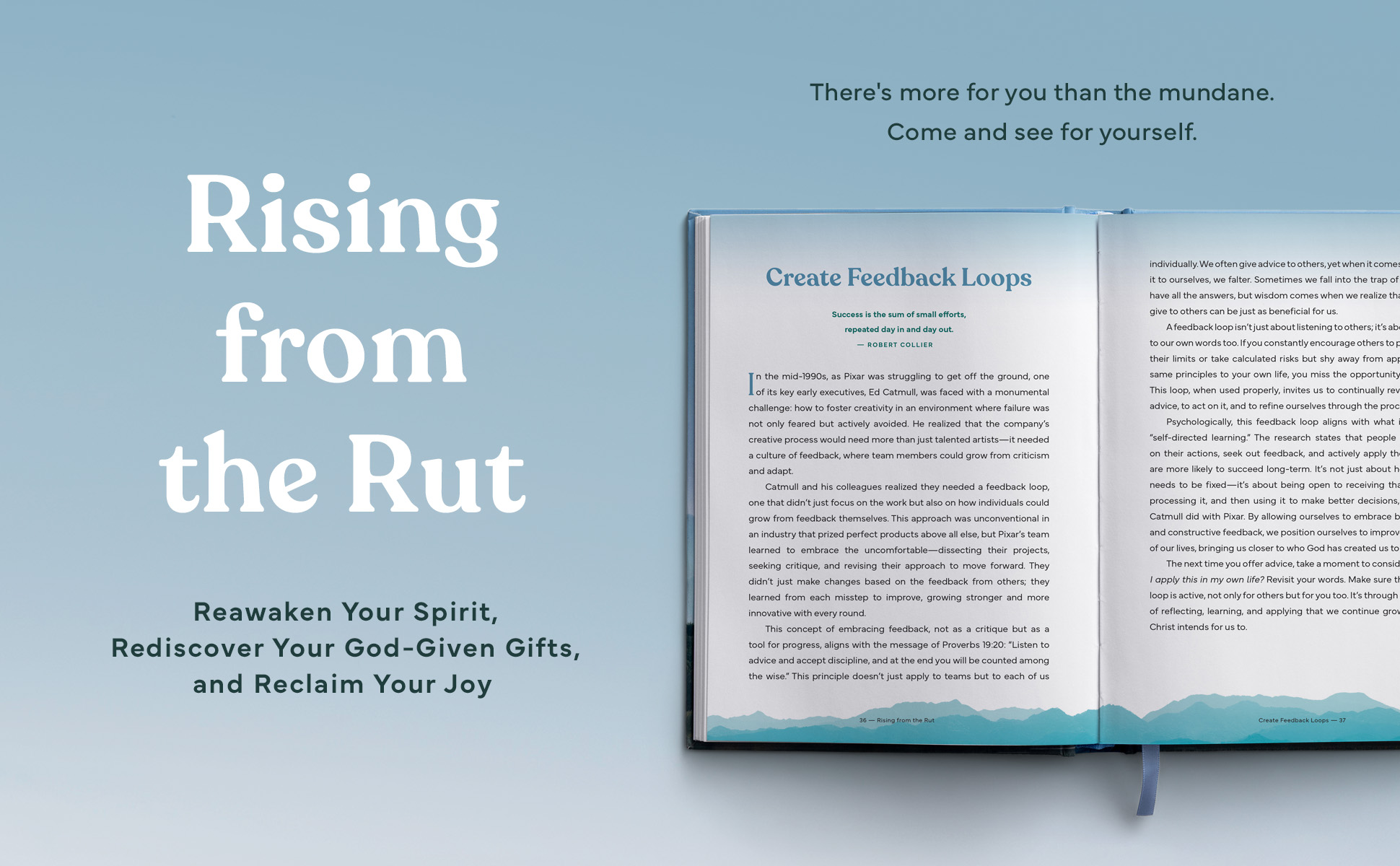
Each devotion in the new book, Rising From the Rut: Reawaken Your Spirit, Rediscover Your God-Given Gifts, and Reclaim Your Joy, by Isis Breanna Bradford, offers a practice to help you reawaken your soul, rediscover your God-given gifts, and reclaim your joy. It’s the perfect time to pick up your copy as we look ahead to ending this year strong and beginning another with God leading the way!

We know you’ll be inspired by this new book. . . so we’re giving away FIVE copies! Just leave a comment answering any of the questions above, and we’ll select five winners at random.

*Giveaway open to US addresses only, and closes on 10/20/2025 at 11:59 pm Central.


Isis Breanna Bradford is a magnetic force in the entrepreneurial world. As a Harvard-certified marketing strategist, author, and speaker, she’s on a mission to transform dreamers into doers, empowering ambitious souls to turn their God-given gifts into thriving lives and businesses. As the heart and mind behind the popular blog The Daily Yes, she encourages subscribers to say yes to messy progress, imperfect discipline, brave pivots, and creative persistence. Find her on Instagram at @isisbreanna and say hello!  

Filed Under: Books We Love Tagged With: Books We Love, DaySpring

Learning to Lean in When Life Presses Hard

October 13, 2025 by Jenny Erlingsson

I placed my giant purse on the floor in front of my padded chair and lifted my hands. The kids were temporarily settled a few seats down, coloring pages in hand, as my husband and I did our best to engage in our church’s prayer night. While the songs overflowed from the stage, I tried to focus — but my shoulders were heavy. I still felt the jagged edges of so many different areas in my life that seemed to scrape against my joy.

I don’t know about you, but sometimes I assume that walking in obedience means the path ahead will be smooth. That’s exactly what I expected, even in the middle of the exhaustion that came with leaving Iceland last year and settling back in the States.

Instead of being rejuvenated by this new season, my husband and I were weary in so many ways.

But we made it to that prayer night, trying to focus and inquire of God over our church and most definitely over ourselves. We desperately needed to hear from God in the midst of our struggle — for everything we didn’t understand in the middle of our yes.

There’s a story in the Bible about Rebekah, the wife of Isaac, Abraham’s son, and how she had questions about the twin babies that grew within her womb. The Bible gives us a clear picture of her process.

The babies jostled each other within her, and she said, “Why is this happening to me?” So she went to inquire of the Lord.
Genesis 25:22 NIV

She went to inquire of the Lord. I have read that passage and sentence multiple times, and even wrote a poem inspired by it. But it takes on a more challenging meaning in times of transition. During that hard season, I didn’t want to turn my face toward inquiring. I grasped for comfort, safety, and quick answers. Instead of anchoring my heart through abiding, I found myself jumping to different sources.

Hmm, what does Google have to say about this? What is the opinion of those around me? What have I done in the past?

That night, remembering the simple, prayerful actions of Rebekah, I lowered my hands and clasped them below my chin. In the middle of that prayer and worship set, I whispered, “What’s going on, Lord? I feel like I am truly between a rock and a hard place.”

In that instant, instead of the reprimand I expected, I sensed the Lord smiling at me.

“Didn’t you ask to be sharpened in the season?” His gentle question pressed into my heart.

Now I don’t recall intentionally praying to be sharpened. But there I was, feeling the tension that had caught me by surprise, but not God. I laughed in that dim sanctuary, God’s voice echoing in my heart as my kids colored fiercely beside me, the ends of their waxy instruments filing down with the effort.

Knives that have been made dull through use don’t get sharpened by flimsy materials; they get sharpened by stone, by rock. Sharpening happens when those tools are rubbed against hard materials that are not comfortable. I was definitely not comfortable, but somehow the circumstances pushing against my life were shaping me. God also reminded me that when flint strikes against steel, sparks fly. I needed joy to be sparked in my life. Joy that didn’t come from the right circumstances, but overflowed out of the leaned-in, inquiring posture of my heart.

These are not the type of devotional messages that I necessarily enjoy. I desire comfort; I like to be cozy. I want to be reminded that I am tucked under the shadow of God’s wings and feel the softness of His feathers upon me.

But comfort doesn’t often move us forward. Sandy soft places aren’t very good anchors. And the process of building our lives on God’s rocky, firm foundation might not be as smooth as we wish. There may be pressing and squeezing, molding and rearranging, and lots of discomfort. Even as we are being sharpened, maybe the words from our mouths come out sharper. Perhaps we are rawer, and situations feel heavier than they would have otherwise.

But we can set our face towards the same sun that Rebekah did.

We can posture our hearts toward the same God she inquired of.

We can lift our own hands in worship to the One she submitted to,

the hands of the One who is ever, always forming us.

And yes, sparking joy along the way.

Listen to Jenny’s devotion here or on the (in)courage podcast!

Filed Under: Encouragement Tagged With: hard places, joy, prayer, struggle, Surrender, transitions

Let’s Pray Psalm 23

October 12, 2025 by (in)courage

Psalm 23
1 The Lord is my shepherd;
  I have all that I need.

2 He lets me rest in green meadows;
  he leads me beside peaceful streams.

3 He renews my strength.
He guides me along right paths,
  bringing honor to his name.

4 Even when I walk
  through the darkest valley,
I will not be afraid,
  for you are close beside me.
Your rod and your staff
  protect and comfort me.

5 You prepare a feast for me
  in the presence of my enemies.
You honor me by anointing my head with oil.
  My cup overflows with blessings.

6 Surely your goodness and unfailing love will pursue me
  all the days of my life,
and I will live in the house of the Lord
  forever. (NLT)

Pause. Breathe. Meditate on God’s Word.

Jesus is the Good Shepherd. He is the help we need.

Now make this your prayer:

Jesus, You are my steady guide and constant provider. When life feels chaotic, You know how to quiet my soul and give me real rest. You don’t just point me in the right direction — you walk with me, giving me strength I could never muster on my own.

When fear creeps in or the path feels dark, remind me that I’m never abandoned. Your presence is my safety, and Your nearness is what gives me courage to keep going.

Even in the middle of hard relationships or difficult circumstances, You remind me that I am seen, cared for, and deeply blessed. My life is not empty — it overflows with Your kindness. Help me to see Your goodness right where I am.

Thank You that no matter what today brings, I can count on Your love to keep chasing after me. And thank You for the hope of forever with You, where peace and joy will never end.

Amen.

Filed Under: Uncategorized Tagged With: prayer, Psalm 23, Sunday Scripture, Uncategorized

Embracing the Autumn of Life

October 11, 2025 by Linda Ann Spicher

Autumn, the third season of the year, between summer and winter.

Can you see it? The bold hues of yellow, orange, and red, painting the mountains or adding a splash of color to the city. Can you feel it? The days grow shorter and cooler. Can you smell it? Mmm, the deliciousness of a warm apple pie coming out of the oven. Can you taste it? It’s fall, y’all. So happy, pumpkin spice everything. Can you hear it? The voices of children laughing and people praising God and giving thanks for a bountiful harvest.

Growing up in Pennsylvania, I was able to experience the fall season with all my senses. Living in Florida, these past thiry-five years, well, let’s just say, the experience of autumn is slightly different but still so beautiful.

However, there is another type of autumn — one that we all, God-willing, will experience. One that may not be full of color, deliciousness, or praise. One that I knew would come but seemed so far away during my spring and summer. Yes, friends, I have entered this new season of life: the autumn of life.

And, with it, came a multitude of different sense experiences including sadness, loss, anxiety, fear, change, and hope. Like autumn in Florida, everything these past few years has come and gone so quickly. The pandemic, my Mom (and best friend) returning home to our heavenly Father, and my Dad (my life-long superhero) has been in the hospital three times in seven months – he is aging and in his winter season of life. I’m becoming an empty-nester, as my oldest child married and moved to Tennessee with her husband. Dear friends have moved away, co-workers have passed away, and I have retired from a thiry-five year career.

Can you relate? Perhaps you are experiencing the autumn of your life or know someone who is.

As I write this devotional, I’m reminded of a few of my favorite scriptures. It’s amazing that on the “coldest” of days, I find myself sitting in the quiet, praying, and somehow these verses show up in my readings. It’s as if God was sitting across from me, at my kitchen table, and we were having a conversation. Our God is truly an awesome God.

For when you “think” autumn has no color: “Finally, brethren, whatever things are true, whatever things are noble, whatever things are just, whatever things are pure, whatever things are lovely, whatever things are of good report, if there is any virtue and if there is anything praiseworthy—meditate on these things” (Philippians 4:8 NKJV).

For when autumn “feels” more like winter: “I can do all things through Christ who strengthens me” (Philippians 4:13).

For when you try to “catch” all the falling leaves: “Trust in the Lord with all your heart, and lean not on your own understanding” (Proverbs 3:5).

Thank you, Lord, for your strength to help open my eyes to accepting change, taking time to breathe, and finding a new purpose as I navigate, with You, these next two seasons of life.

So, friends, let’s look at the autumn of life as we do the actual season of autumn. Embrace the beauty, change, and gifts of every season life has to offer, knowing He is with us every step of the journey. I welcome, and challenge you to welcome, the changes that come with the autumn of Life.

Take a moment to breathe the fresh air and reflect on your life’s journey thus far. As leaves fall, remember change is natural and inevitable. Harvest the fruits of your labor.

And be thankful for the bold and beautiful colors God has bestowed upon you this season.

Filed Under: Guest Tagged With: Change, fall, gratitude, life, seasons, seasons of life

  • « Go to Previous Page
  • Page 1
  • Page 2
  • Page 3
  • Page 4
  • Page 5
  • Page 6
  • Interim pages omitted …
  • Page 142
  • Go to Next Page »

Primary Sidebar

Receive daily devotions
in your inbox.
Thank You

Your first email is on the way.

* PLEASE ENTER A VALID EMAIL ADDRESS
  • Devotions
  • Meet
  • Library
  • Shop
©2025 DaySpring Cards Inc. All Rights Reserved.
Your Privacy ChoicesYour Privacy Choices •  Privacy Policy • CA Privacy Notice • Terms of Use