
Menu
  • Home
  • Daily Devotions
  • The Podcast
  • Meet (in)courage
    • Meet the Contributors
    • Meet the Staff
    • About Us
    • Our History
  • Library
    • The (in)courage Library
    • Bible Studies
    • Freebies!
  • Shop
  • Guest Submissions
  • DaySpring
  • Privacy
  • Skip to primary navigation
  • Skip to main content
  • Skip to primary sidebar
(in)courage - Logo (in)courage

(in)courage

Stay and Remain in His Love

Stay and Remain in His Love

May 29, 2021 by Anjuli Paschall

Every day my husband leaves for work, and our daughter Mea, like a little duckling, follows him outside. He gathers her up in his arms, kisses her, then proceeds to start his truck and drive away. I stand in the driveway beside her as she waves frantically at his departure. We move from the driveway to the middle of the street and watch his truck become toy size. I try and negotiate a way to get her back inside because I am still in my sweats and nightshirt, but Mea doesn’t budge. She waves her hands high until he turns the corner and his truck is out of sight. Once he is gone, I can nudge her back inside and, finally, get on with my day.

I don’t like goodbyes. Especially the goodbyes when a “hello again” can’t be penciled in on the calendar. This month, two family members are moving and taking my nieces and nephew with them. I’ve been lucky enough to have my family close by. For years, we’ve gathered for holidays, Sunday lunches, and summer swims. It has always been joyous and convenient. One family is moving to Texas and another Florida. I have no idea when we will all be together again.

We gathered for Mother’s Day and as we prayed before the meal, our arms looped in and around each other’s arms like pretzels. It felt safe. After the kids played tag, burned things in the bonfire, and finished the coconut cake, we all slowly said goodbye. There were tears and laughter to ease off the sadness, but days that once seemed so normal will now be “remember when” stories. I wanted to scream, “Please don’t leave!”

I’m not good with transition or change. I always order the same Starbucks drink. I don’t like trying new restaurants, and I’ve been driving the same car for, well, forever. But there is so much transition right now. Soon, my son will enter high school, and my youngest will start preschool. For the first time in fifteen years, I won’t be managing nap time or changing diapers. To be honest, this change scares me. Who am I without a baby? What do I do with my time? What do holidays look like without all of our extended family?

Transition is painful. The anticipation of it is grueling. I am tempted to pretend it isn’t coming. I look away at other more delightful things. I focus on the positives. I binge-watch old episodes of my favorite TV show. I distract myself from reality just long enough not to feel the sting of it. But we are all in some sort of transition. We’re all pressing on the gas and looking in our rearview mirrors. We’re scattering new seeds and pulling up unwanted weeds. We’re always starting something new and letting go of something old. We aren’t called to do transition perfectly, but we can learn how to do it well.

I remember the words of Jesus before He transcended to heaven. He walked, talked, and lived among the disciples and hundreds more after His resurrection. His words of love before He left them went like this, “As the Father has loved me, so have I loved you. Now remain in my love” (John 15:9 NIV). The word that stands out to me the most is — remain. Stay. Up until the very last moment, Jesus stayed with those He loved. He invited them to remain in His love. Even in the change, the only constant is Christ’s love.

I lean into the love of Christ today. With every word of my sad story of change, I trust in the sturdiness of God’s love. I don’t have to glance away when goodbyes are coming. I don’t have to only find the pretty. I can hold grief and gratitude in the same hand. Transitions can be hard. I can keep them at arm’s length, or I can enter them with the hope that God’s arms will reach me no matter what uncontrollable circumstances come my way. I can be like my daughter who waves goodbye enthusiastically until the very last moment.

The invitation to you, dear sisters, in the midst of change is to remain in Christ’s love. Lean heavy on His side. Loop arms with His. No matter how scary or unwanted the transition may be, God’s invitation is to remain in His love.

Filed Under: Encouragement Tagged With: remain, Stay

Responding to Violent Words with Words of Peace

May 28, 2021 by (in)courage

Last year, I received an email I wasn’t supposed to. From the opening line onward, there was a detailed list of complaints that an individual held against me with insults and slander throughout. It was one of the most painful emails I’ve ever read. At the core of the matter were differences in theological positions but also a dislike of me as a female speaker and leader. Even worse, this person was sharing their thoughts with a large group of fellow brothers and sisters in Christ, asking them to boycott me and my work. I would have never known about any of this except somehow my email address was accidentally included.

I wrestled for a long time with what to do with that email. Should I respond? Should I reach out to the person? Should I expose this email to the online world and vindicate myself of what I felt to be false accusations? After much prayer and counsel from respected friends and the elders of my church, I chose not to respond.

Sometimes we can engage with folks who truly desire to have a productive conversation and are willing to engage us with mutual respect. We can clarify, perhaps educate too when necessary. But usually when negative words come flying at us, the best thing we can do is to first hold our own tongues. We can exercise self-control and choose not to sling the metaphorical mud back at our accuser.

Jesus models for us how to respond to violent words with words of peace. Jesus, our Prince of Peace, gives us peace at all times in every way (2 Thessalonians 3:16). In fact, Jesus’ peace is to rule over our hearts (Colossians 3:15), and He encourages us by saying, “Blessed are the peacemakers for they shall be called sons and daughters of God” (Matthew 5:9). The writer of that email had no interest in personally engaging with me, and I knew that fighting back, even defending myself, would not lead to peace. In fact, speaking angry, hurtful words back at my accuser would have only created more division and tension, not reconciliation.

Violence of any kind only perpetuates more violence. We often think of violence only in terms of our bodies, but words can be just as damaging. James 3:6 says, “The tongue also is a fire, a world of evil among the parts of the body. It corrupts the whole body, sets the whole course of one’s life on fire, and is itself set on fire by hell.” Verses 9-10 continue, “With the tongue we praise our Lord and Father, and with it we curse human beings, who have been made in God’s likeness. Out of the same mouth come praise and cursing. My brothers and sisters, this should not be.” Painful words linger with us long after they’ve been spoken. As Xochitl Dixon says, “Negative words often appear to have the sticking power of superglue.” Months, even years, can go by, and the wounds of accusations, insults, and lies can feel just as raw as ever.

Lashing back out, however, is neither helpful nor biblical. Winning an argument may make us feel better for a moment, but it doesn’t show love and peace to a other person. In the movie, You’ve Got Mail, Meg Ryan tells Tom Hanks that she’s always wanted to be able to say just the right words in just the right moment to stick it to someone. When she finally gets her chance, though, she feels terrible afterward. Putting someone in their place never satisfies us in the way we think it will.

I’m continually challenged by the words of Romans 12:17-19, which states, “Do not repay anyone evil for evil. Be careful to do what is right in the eyes of everyone. If it is possible, as far as it depends on you, live at peace with everyone. Do not take revenge.” Think about that line for a moment: “If it is possible, live at peace with everyone.” This is incredible and perhaps one of the hardest challenges for us even still today.

We live in an age of cancel culture, of critiquing everyone for everything. Instead of making space for each other, whether it’s our different theological views or stances on the hot topics of the day, instead of learning to live in the tension and awkwardness of finding a way to get along, we say, “It’s my way or the highway.” Everything is either this or that. You’re either on “my team,” or you’re my enemy. None of this is living with a posture and heart for peace.

God challenges us to a better way. He invites us to forgive again and again, to be slow to speak and slow to anger, to cling to God’s Word and find healing in the knowledge and truth of who God says you are. We live in a violent, broken world, but we can be agents of transformation, breaking cycles of violent words and replacing them with words and indeed realities of peace.

Filed Under: Uncategorized Tagged With: Community, kindness, nonviolence, peace, words of peace

Nothing Is Wasted — Even the Pains of Our Past

May 27, 2021 by Bonnie Gray

It’s been said that life is a blank page, but because of my mother’s fate, the script for my life was already written.

Ah-Ma was a teenage mail-order bride from Hong Kong married to a busboy working in a noodle shop in San Francisco Chinatown. He left me when I was seven years old.

Six-month-old me and eighteen-year-old Ah-Ma on our back porch in Chinatown

Ah-Ma is “mom” translated from the Chinese Cantonese dialect. The second girl of eight kids, Ah-Ma’s mother chose her to marry a stranger ten years older to immigrate her family to the land of opportunity. She had dreams of a better life, but I had different dreams of my own.

So, what would you do if you found yourself in the middle of a story you never intended to choose for yourself?

I never told anyone about the real story behind Ah-ma or my father because I always felt those were the parts of my story that made me feel weird, flawed, and out of place. So, I just cut those parts of my story out.

All my life, I grew up hiding my heart, trying to be “normal” like everyone else. I was stuck between two worlds: at home, I was Chinese Bonnie, the oldest daughter taking care of my little sister Mei-Mei, walking her home from school, helping with homework, and putting aside my work when it was dinner time. I’d stand over the kitchen sink, swish-swashing bok choy and then I’d throw a wok over the stove top to stir-fry a meal of sliced chicken, julienned green onions, and a generous splatter of minced garlic.

But the minute I stepped outside my doorway, I became American Bonnie, where I felt I could only talk about the things that happy, shiny people talked about. Without a place where I could fully belong, I walked around split into two halves that lived in different worlds and was never fully present in either. It was a bit like the children in The Lion, the Witch and the Wardrobe, who traveled beyond the wardrobe but could never bring Narnia back with them.

I was never whole Bonnie anywhere.

To navigate my life as an adult, as a wife, and as a mom to two boys, I decided to create a new story with my own family. I told myself, Leave the past where it was, Bonnie. I never wanted to talk about the family secrets that left me feeling like I didn’t belong anywhere, but God knew how to reach me — through my curiosity.

One day, I was rummaging in an old file cabinet and stumbled upon an old forgotten birth certificate. I realized I had never seen the home I was born into and set out to find my childhood home and my father in San Francisco’s Chinatown to uncover the family secrets I had run away from.

What I discovered about my past has become my story of how God creates beauty out of brokenness as we discover our true worth in God’s love.

Can you relate to having different parts of your life split up between your private world, where you hide your wounds, and the outside world, where you perform, please, or achieve?

The truth is, we’re all on a journey to find belonging out of loneliness and beauty out of brokenness.

God has given each of us a unique set of cultural heritages, with a rich diversity of stories and different types of families, to show the world He is powerful to carry us through every imaginable human experience. When we open up about our lives and share our stories, others can see that nothing is wasted under the power of God’s loving hand. And because of God’s never-ending, faithful, and healing love, you and I no longer need to hide our brokenness.

God values and treasures the beautiful parts of you that others have overlooked. God tenderly whispers, You are my treasure. I cherish you.

We become beloved.

Over the pandemic, I wrote about my Asian American stories of faith and placed them in a new book named Sweet Like Jasmine. And for the first time, I read those stories to my children, Josh and Caleb. They can see that God was at work in all the parts of my story, and now I stand unashamed, embracing who I am as both Chinese and American and living whole as God’s beloved daughter.

Get a FREE audiobook of my new book Sweet Like Jasmine: Finding Identity in a Culture of Loneliness and exclusive access to the book club by signing up here! I’m so excited to empower you as God’s beloved!

Filed Under: Courage Tagged With: Asian-American, culture, ethnicity, Identity, race

Two Tiny Words That Hold the Power to Reframe Failure

May 26, 2021 by Michele Cushatt

“So, basically, I blew it.”

Twenty minutes before, I’d walked into my counselor’s office with a light step and confidence. But after replaying the events of the prior weekend and talking through the words said and choices made, I knew I’d failed. Again.

My good mood escaped like air out of a balloon. How had I let that happen? I’d tried so hard to get it right. But here I was, once again, on the back side of an altercation, discovering I hadn’t handled it as well as I had thought I had. Nothing traumatic or irreparable. Still, I knew I had, in fact, blown it — in spite of my efforts to do otherwise.

Defeat pushed me deeper into the leather of her sofa. At the same time, another feeling niggled its way to the front, coloring my neck and face.

Embarrassment. I felt embarrassed.

“I can’t believe I blew it again,” I said, shaking my head back and forth in disbelief. When would I finally get this right?

But she didn’t agree with my conclusion.

“You didn’t blow it,” she said matter-of-factly. “You’re learning.”

I don’t think I said anything for a full minute after that. Her words stunned even more than my assumed failure.

Excuse me? I wanted to say. Did you not hear my story?

But she’d heard. Now she wanted me to hear — not my words, but hers. The ones in which she exchanged my words for better ones.

You’re learning.

I’ve thought of her words countless times since that day, while coaching individuals and consulting with organizations. I’ve shared them with members of my team and offered them as a soft gift to a young woman I mentor. But more than using her words to serve others, I’ve used them to serve myself and my own heart.

I’ve long been merciless with my self-flagellation. I remember moments in childhood when I beat myself up for any and every infraction. I thought that was what you were supposed to do when you failed — punish yourself enough and you’re not likely to repeat the same mistake.

But shame and self-loathing aren’t good companions. And, as it turns out, it doesn’t do much to change human behavior. Instead of inspiring change, self-recrimination fuels shame. And shame is a poor teacher.

With her two words, my counselor changed my position after my inevitable mistakes. Rather than positioning myself at the other end of a whip, I prop myself in the chair at the front of the classroom.

Paul said it this way:

Therefore, there is now no condemnation for those who are in Christ Jesus.
Romans 8:1 (NIV)

In Christ, I am not condemned. Instead, through the power of His presence in me, I am slowly being transformed into His likeness, one day and moment at a time. That means I am a student, not a screw-up. And this shift — as small as it appears — changes everything about my human experience. It changes how I see me, how I process my many mistakes and failures. It helps me turn shame into confession, failure into growth. And, like a buy-one-get-one-free deal, it also changes how I perceive other mistake-laden, imperfect humans just like me.

In other words, I’m a student, not a screw-up. And so are you.

We’re all learning, doing our best to be our best, even when some days all we offer is our worst.

In fact, we’re learning together — if, of course, we can lay aside our whips long enough to let compassion and empathy connect us.

What about you, friend? What is your typical self-talk when you realize you made a mistake? Whether you say it out loud or not, there is a narrative you follow. And that narrative will either lead you to a prison or a classroom.

The good news? You get to choose. So choose well.

Filed Under: Encouragement Tagged With: Grace, Growth

The Importance of the Living Table

May 25, 2021 by Abby Turner

Born and raised in Arkansas, I’m as Southern as a girl can get. If my two sisters and I weren’t at school, we were at church, and if we weren’t at church, we were sitting around the table eating together. The table — it’s where I grew up, the place where I laughed, cried, shared exciting news (and not so exciting news), debated with my sisters, and opened my heart to Jesus. I didn’t realize how much that table meant to me until I moved away.

At age twenty-four, I moved to Birmingham, Alabama. For the first time in my life, I lived alone and worked long hours, leaving little time for community and friendships. Lonely and depressed, I thought my life was incomplete because I was single. I threw myself at dating apps and constantly felt discouraged. After weeks of hearing me complain about my terrible life, my mom offered me the best advice I’ve ever received: “God calls us to serve people. Why don’t you cook a meal and invite people over?” And then she finished with a phrase that she has repeated over the years to my sisters and me: “Be a blessing.”

After rolling my eyes and grumbling for longer than I would like to admit, I took my mother’s advice. I cracked open a cookbook and hosted dinner for friends for the first time in my adult life. The four of us squeezed around a table for two — and had the best time. I will always remember that night because I made four-cheese tortellini. It was terrible. But that night God taught me something important: I was lonely, not because I was single, but because I had not been investing in and nurturing a community in my life.

That night Jesus ignited in me a desire for community, a realization of the importance of the table, and a curiosity for the art of hospitality. Fast-forward seven years and here we are.

After four years of cooking for friends and hosting dinner parties every week (around my very small apartment table), I decided to share my love of hospitality with the world and launched my blog, A Table Top Affair. I also started posting my recipes and party ideas on Pinterest and Instagram. I wanted to encourage people who were stuck in a rut, people who didn’t know how to meet others or how to cultivate their own community. So I began trying to put a formula to it — a formula for empowering people to overcome their insecurities in the kitchen and to truly invest in opening their homes even though they might not have the picture-perfect family.

It took me being single and lonely to see that God had big plans for me around my kitchen table. If I wasn’t single or had put off embracing hospitality until I had a husband and 2.5 kids, I would have missed all the memories, relationships, and conversations about Jesus around that table.

At some deep level, I believe we are drawn to the table. When Jesus said, “I am the bread of life,” I believe He literally meant for us to bring people to the table and serve them and to let Him do the rest. When we set the table and prepare a meal, there is something supernatural that happens to our hearts. It’s undeniable!

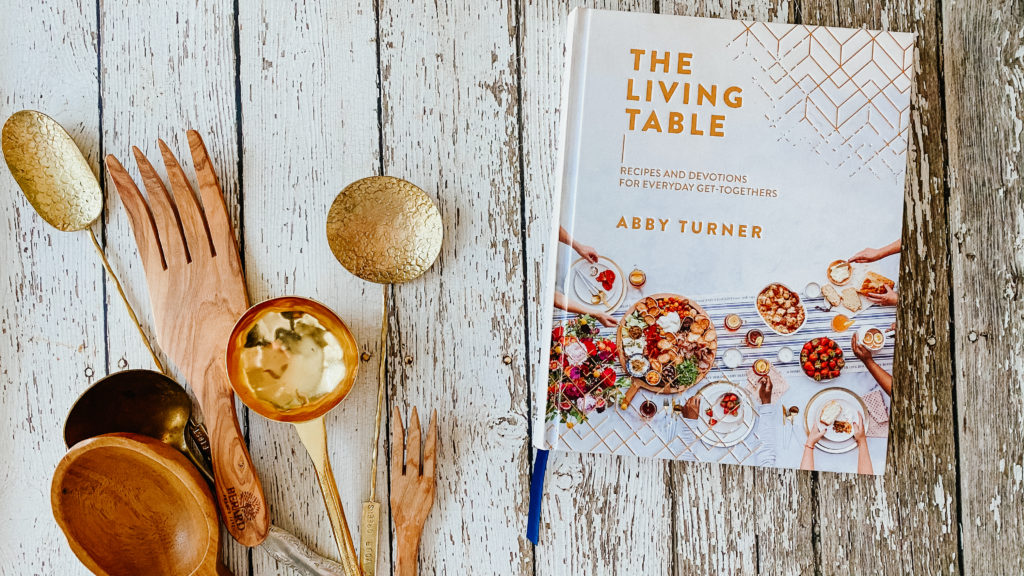
Throughout my book, The Living Table, it is my hope that you will be inspired to clean off your table and prepare to serve others. In fact, I have an easy go-to handbook that is full of tips on how to be prepared to serve. Trust me, I know life gets overwhelming and busy, but God longs for us to release all our pressures to Him. He wants us to live peaceful lives — lives that are full of joy and fellowship.

No matter what phase of life you are in (single, married, mom with littles, empty nester, or recently retired), loneliness can overwhelm any one of us. It’s our community that encourages us through the ups and downs of our lives, and through these interactions we get to experience the joy of God’s goodness. So, what do you think? Is God calling you to dust off your table and open your door? If so, why not follow His lead? After all, He will be with you throughout the process, giving you everything you need.

My prayer is that the joy of hospitality that permeates the pages of this book will begin to infect your life.

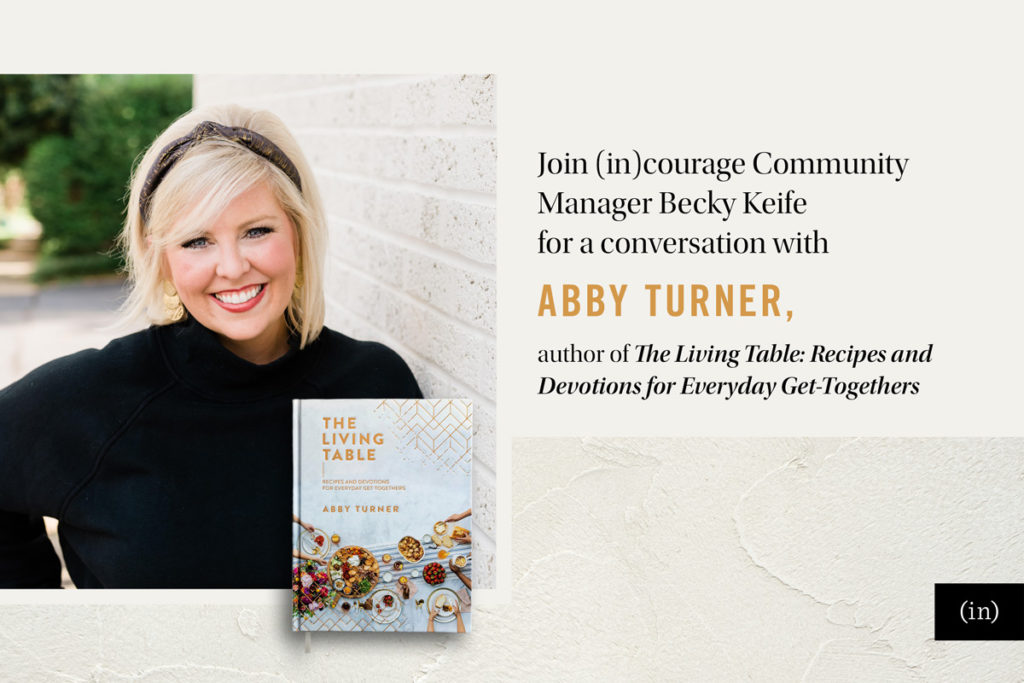
In The Living Table: Recipes and Devotions for Everyday Get-Togethers, Abby Turner shares easy-to-recreate recipes and fun DIY projects that take fifteen minutes or less. Each section starts with a first-hand account of the miraculous ways God has showed up at Abby’s table — how deep conversations have led to deep spiritual growth, how a new friend has become a forever friend, and how tears and laughs and mishaps have become treasured memories. With each section focusing on specific tables (dinner table, coffee table, outside table, etc.), you’ll discover fast and easy ways to liven up any moment, whether that be Tuesday night home with family or a well-thought-out Thanksgiving.

God is asking each of us to open our homes and prepare our tables, and The Living Table devotional cookbook equips the most intimidated hostess. Hosting isn’t about being perfect; it’s about offering care to one another and building community.

To celebrate this beautiful new book, we are giving away FIVE copies of The Living Table!*

To enter, tell us in the comments how you cultivate community right where you are, and we’ll choose five lucky winners!

Then tune in tomorrow, May 26th, at 11:00 am CST on Facebook for a conversation with Abby Turner and Becky Keife as they discuss The Living Table.

*Giveaway is open to US addresses only and ends at 11:59pm CST on May 28, 2021.

Filed Under: Books We Love Tagged With: Community, Recommended Reads, The Living Table

What Did David Know That I Don’t?

May 25, 2021 by Sarah M. Guerrero

When I was eight, I memorized Psalm 23 to recite before our church. I climbed the steps, turned to face the audience, and promptly came down with the worst case of stage fright anyone’s ever experienced in the history of stages.

Other than that awful moment, Psalm 23 has stuck with me. But recently, it became like new when I was struck by an image from verse five:

You prepare a table before me in the midst of my enemies.

Psalm 23 is attributed to David, the shepherd king, and in this wild verse, the shepherd sees his threats but he doesn’t square himself to fight back. He doesn’t reach for a slingshot or a staff or a sword. He doesn’t run. He doesn’t hide.

He sits down.

In the midst of his troubles, he sees a table set for him deliberately, and he sits down, tucks in his napkin, and (I imagine) eats.

I couldn’t shake the image. What did David know about warfare and trouble that I don’t know? David’s enemies were literal killers (lions and bears, Goliath the giant, Saul the manic king who hunted him for almost a decade), and though my enemies aren’t the same, they’ve still felt consuming: crippling self-criticism, fears in the dead of night about God’s goodness, questions about evil that don’t seem to have answers, anger, racism that sabotages my theology, and misogyny. 

But what if I learned to fight my enemies by sitting down to feast? 

It’s a question that has changed my life. As I’ve sat with Psalm 23, my eyes have been opened over and over again to what I’ve become consumed by in search for scraps. I beg for crumbs when all along, there’s a table groaning with good food and a chair with my name on it.

David’s feast is the answer to my enemies.

Instead of scathing condemnation for myself and the people around me, when I sit down at the Psalm 23 feast, I find a platter heaped with my favorite fried, lightly glazed donuts, delicious little pillows of tender compassion and serene acceptance. I find an unending basket of chips and queso, a little bowl of happiness in the form of thanksgiving and gratefulness to ward off the worry. There’s a pot of pinto beans, like my grandmother used to make, to remind me that if evil seems endless, love never sleeps. There’s also a fresh-baked apple pie à la mode with a flaky, buttery crust, to comfort me while I give space to my anger and find that it was grief all along. A bowl full of perfectly ripe Georgia peaches sits on the corner of the table, and as I tear into them, the juices drip down my chin, a reminder that God is both a righteous judge and the payment for my sin.  

This Psalm 23 feast is abundant beyond our wildest dreams, and everything we need is before us. So, how do we learn to sit and eat? We learn to receive God’s love and acceptance, just like Jesus did.  

When Jesus was getting baptized, the heavens opened, and a voice from heaven said, “This is my Son, whom I love; with him I am well pleased” (Matthew 3:17 NIV). He hadn’t begun His ministry, fed the five thousand, walked on water, raised the dead, or died sacrificially, and still He was entirely loved and accepted by God. And if we are in Christ, so are we.  

The goodness of God takes many forms at David’s Psalm 23 feast. It is the answer to every fear that keeps us up at night, to every surge of anger that takes our breath away. And it is ultimately expressed in Jesus’ sacrifice on our behalf. Jesus’ body was broken for us, His blood was spilled for us, and this is the feast of goodness God prepares for you right now, in the midst of your enemies — His abundant love, grace, help, and presence.

The table is prepared for you, just like it was prepared for David. Just sit down and eat.  

Filed Under: Encouragement Tagged With: Psalm 23

Here Together, Alive and Real

May 24, 2021 by Grace P. Cho

Tennis shoes, Ugg boots, Converses, and flip flops litter the entryway. It’s the typical yet eclectic assortment of footwear for those of us who live in Southern California, where it’s mild for most of the year with the occasional staccato notes of actual cold and hot. They look so happy all jumbled together on the tile floor, and I snap a photo to remember the feeling of the moment: full. The boisterous laughter from the adult table that comes from a lifetime of knowing each other, the gaggle of children running back and forth through the hallway screaming with delight, the silver disposable trays filled with barbecued meats and sides lined up on the kitchen countertop — the house is full in every sense of the word, and in that moment, I know if I let myself really feel the overwhelming love I’m witnessing, I’ll burst into tears.

Now, the entryway is tidy, with shoes lined up along the wall. It’s been too long since we’ve been able to bring the extended family together with the deaths of both grandparents this past year and because of COVID. With grandma and grandpa gone, it feels like we’re strings loosely strung together, slowly unraveling in the wind. Perhaps we’re not ready to be together because it will force us to face the grief yet again. Perhaps they were what kept us tight, and we need to find new ways to weave ourselves back toward one another again. Perhaps we don’t know how to simply be and enjoy each other’s presence because the last few times we had gathered were for mourning and not rejoicing.

I long for nearness again with people — to sit in coffee shops for hours and spend too much time wondering about the couple sitting next to me instead of writing, to tilt my head back and laugh out loud without worrying about the amount of bacteria erupting from my mouth, to freely embrace friends instead of elbow bumping each other out of caution. Nearness feels like a luxury, a dream for later days, the answer to my children’s prayer at every meal: “God, please make the coronavirus go away.”

I have such few words when I pray these days, so I simply repeat the same words again and again: Lord, Lord, Lord, be near, be near, be near. Again and again, I ask for His presence to penetrate through hospital walls, isolated minds or tension-filled relationships, like the time Jesus showed up in the upper room to a group of frightened disciples. I ask for the miraculous, knowing that many today are like those disciples — alone, unsure, and stuck inside a room. His nearness didn’t make sense to them, so Jesus invited them to touch and see His hands and feet, to give Him something to eat because He was real and not a ghost.

Luke 24:41 says, “[The disciples] still did not believe it because of joy and amazement,” and I wonder if they were like me these days, squeezing the arms of the few friends I’ve seen in person, saying, “You’re real. You’re here. We’re here.”

It’s no wonder that we long for nearness because God came near to us first. He walked in the Garden of Eden with Adam at the beginning of time and then sent His Son to be born as a baby so He could make His dwelling among us (John 1:14). We weren’t only created for community but also for the physical nearness that being in community provides. Being with each other is a taste of God Emmanuel.

One day, I hope we can jump up and down while hugging each other not just because we’re vaccinated but because we just don’t have to worry about getting sick anymore. One day, I hope rubbing shoulders with strangers again and seeing their whole faces will remind us that we’re fellow human beings navigating complicated lives, that we’re more than tiny, smiling icons on a social media profile. One day, I hope the entryway gets filled with shoes haphazardly strewn about — a reminder that we are here, together, alive, and real.

Filed Under: Uncategorized Tagged With: Community, gathering, nearness

Giving Grace in the Days of COVID

May 23, 2021 by Dawn Camp

I can easily recall my emotions from the early days of the pandemic: fear of catching the virus, nervousness that every person or surface I encountered was covered in it, paranoia each day when my husband went to work that he would be exposed and bring it home, and uncertainty for the future.

At the same time, I was fascinated by the idea that our planet shared a group experience. Working from home (or not at all) became the new norm. A tank of gas could last for weeks. We washed our hands like surgeons, counted our rolls of toilet paper, compared notes on the best grocery store delivery services, and searched our homes for the spots with the best lighting and backdrops for Zoom meetings. So many of our concerns felt universal.

Now it’s spring 2021, and we’re adjusting to life in a hopefully waning pandemic. I drive around less than before COVID but shop in person more than I did last year. I participate in two book clubs. My children experienced a fairly normal track season and attended their state meet. Our family sold our house and moved recently. These things feel blissfully ordinary, and I’m thankful for it.

Last March our lives changed radically, almost in the blink of an eye. We’re emerging from the pandemic at a slower pace than we entered it. Stores, restaurants, schools, and theaters closed all at once but are now reopening on their own timetables. We are re-emerging individually on our own timetables too.

Many of our families have been touched by COVID either directly or indirectly; two of my eight children contracted the virus last fall. Understandably, each of us will resume our normal activities and level of social interaction at a different pace, at our own comfort level. Situations that now feel comfortable to you may still leave your best friend or your husband unsettled — or vice versa — and that’s okay.

It’s okay if you’re ready to resume life as usual, and it’s okay if you’re not. It’s okay if you’re comfortable or uncomfortable in public or with groups of friends. The pandemic presented us with an unprecedented-in-our-lifetime shared experience, but our responses to it are varied and unique.

And although COVID took many things from us, it’s offered us an opportunity to extend to each other a new kind of grace: learning to live peaceably with one another even when we don’t agree on how we should be responding. 

If it is possible, as far as it depends on you, live at peace with everyone.
Romans 12:18 (ESV)

Lately, I’ve been feeling the tension of having to make decisions that have no easy right or wrong answer and to know that my friends and family members — including my own children — may or may not agree with my choices. I ponder the question, What would Jesus do?, to guide my decisions, and I understand that my answer to that question could differ from others — whether that has to do with vaccines or gathering in person for church or traveling. I don’t know how He might’ve responded to this pandemic and the choices we’ve all had to face, but I believe He would’ve grieved with those who grieved, rejoiced with those who rejoiced, and loved everyone well. He was the ultimate giver of grace.

This pandemic has forced us to make decisions we may feel ill-equipped to make, and I need to keep reminding myself that while we may not come to the same conclusions, we’re all doing the best we can.

Members of my immediate family have made different decisions regarding social distancing and the vaccine, and we’ve learned to treat each other’s decisions with respect. I can’t choose for them and they can’t choose for me, but we can choose to give each other grace and show kindness when we don’t agree.

Matthew 5:9 tells us, “Blessed are the peacemakers: for they shall be called the children of God.” A peacemaker doesn’t just listen to words but to the people who speak them. A peacemaker listens with more than ears; they listen with their heart. The pandemic has disrupted our lives physically, socially, and emotionally. Let us be peacemakers and grace-givers who help to bring healing as we seek to understand each other’s choices and give each other grace in the days of COVID — and beyond.

Filed Under: Uncategorized Tagged With: Community, covid-19, Grace, reentry

Being Honest Instead of Just Being “Fine”

May 22, 2021 by Renee Swope

I was standing in the lobby at church waiting for my husband when a friend I hadn’t seen in a long time walked up and asked how I was doing. Should I be honest? I wondered. What if she’s just asking to be nice? What if I start crying, and she doesn’t have time to listen?

I could keep it simple and say, “I’m fine,” but I knew I’d be lying. I wasn’t fine. I was exhausted, overwhelmed, and really sad. Our daughter had recently been diagnosed with significant developmental delays and multiple learning disabilities. And I was carrying what felt like 500 pounds of uncertainty, not knowing what our little girl’s future would look like or how much to share with others because I didn’t want them to see her differently.

It’s hard to let people know how we’re really doing when the burdens we carry aren’t just our own. Sometimes I act like I am fine because I don’t want to seem weak or like a high-maintenance friend. It’s also easy to think people don’t really want to know when they ask. The truth is, sometimes they are just being nice.

But what about those times when someone sincerely wants to know and I still don’t want to tell them? Honestly, there are times when I will say I’m fine because I want to be. I think that by saying that I can somehow move my emotions in that direction instead of dealing with the messy emotions that are bubbling up inside of me. There have been times when I say I’m fine because I think others expect me to be, whether that’s true or not. And there are also days when hormones and sleep deprivation trump all good manners and if my people are within ten feet they know I am not fine. In fact, if I say I’m fine what I really mean is I’m feeling frazzled, irritated, neurotic, and exhausted!

But not in public — not when telling someone how I’m really doing feels like too big of a risk. And that is how I felt that day in the lobby at church. At a pivotal point of decision. Will I be honest and let her see all of me? Should I let her know how I’m really doing?

Everything in me wanted to keep my guard up, my lips sealed, and my heart safe. But I was tired — tired of pretending I was fine. So I took a risk and let my heart, my words, and my tears spill. I shared the hard parts of countless assessments and these unexpected diagnoses, and the fear of not knowing what our girl’s future would look like.

My friend listened and offered to help. She also prayed for me, and then she thanked me for being willing to be honest and let her know what was really going on. Before she walked away, she paused and told me how often she looked at my life and assumed I was fine and had things all put together. But knowing I needed help, prayers and encouragement — and didn’t have it all figured out — made her feel normal.

That day I saw God working His grace and His strength in my weakness, and I was reminded of the promise the Lord had made to the apostle Paul when He told him, “My grace is sufficient for you, for my power is made perfect in weakness” (2 Corinthians 12:9 NIV).

I am learning that when I’m willing to be weak, God gets to be strong. And when I’m willing to be real, others get to see, pray for, and get to know the real me and the real God I desperately need and love.

Filed Under: Courage Tagged With: Community, vulnerability

A Woman of Courageous Influence

May 21, 2021 by (in)courage

A woman from Samaria came to draw water. Jesus said to her, “Give me a drink.” (For his disciples had gone away into the city to buy food.) The Samaritan woman said to him, “How is it that you, a Jew, ask for a drink from me, a woman of Samaria?” (For Jews have no dealings with Samaritans.) Jesus answered her, “If you knew the gift of God, and who it is that is saying to you, ‘Give me a drink,’ you would have asked him, and he would have given you living water.” The woman said to him, “Sir, you have nothing to draw water with, and the well is deep. W here do you get that living water? Are you greater than our father Jacob? He gave us the well and drank from it himself, as did his sons and his livestock.” Jesus said to her, “Everyone who drinks of this water will be thirsty again, but whoever drinks of the water that I will give him will never be thirsty again. The water that I will give him will become in him a spring of water welling up to eternal life.” The woman said to him, “Sir, give me this water, so that I will not be thirsty or have to come here to draw water.”

Jesus said to her, “Go, call your husband, and come here.” The woman answered him, “I have no husband.” Jesus said to her, “You are right in saying, ‘I have no husband’; for you have had five husbands, and the one you now have is not your husband. What you have said is true.”

…

The woman said to him, “I know that Messiah is coming (he who is called Christ). When he comes, he will tell us all things.” Jesus said to her, “I who speak to you am he.”
John 4:7-26 (ESV)

The Samaritan woman was at the right place at the right time. This likely came as a surprise to her since she was drawing water in the middle of the day rather than the more common morning hours, possibly to avoid the townspeople who knew of her sins and were critical of her lifestyle. Assuming no one else would want to face the heat, she probably walked to the well in the hottest part of the day with hopes to be alone, to be left in peace. But on this day her plans to keep to herself were thwarted by an unexpected Jewish man asking for a drink.

How startling and confusing and maybe even frustrating that encounter must have been at first! Not only was the well not deserted as she expected, but here was a man — a Jewish man — speaking to her — a Samaritan woman! Though she was acquainted with breaking the rules, she was likely surprised that a religious teacher would do so.

Perhaps the shock of the situation is what emboldened her to question Jesus outright, asking why He spoke to her and where He got the mysterious living water He mentioned. Or perhaps she was simply moved that someone would speak to her kindly and openly. Maybe she thought she’d take advantage of a stranger’s ignorance of her reputation and enjoy a conversation with someone who knew nothing of her past.

What the woman quickly realized, though, is that this was no stranger, and He somehow knew secrets about more than water. He knew her, past and all. Though she’d never met Jesus before that day, and He was presumably a visitor to her town, He knew exactly who she was and what she’d done. But what was equally baffling to this intimate knowledge was His response to it — and to her.

Even knowing what He did about her, Jesus still spoke to the woman at the well. He still asked her for water, then offered her living water. Though He named her sins and forced her to face the truth of her choices, He offered her mercy. He knew her — and He loved her anyway.

He did not condemn her, but instead, revealed her sin for what it was and allowed her to see the truth. He showed her the difference between the life she had and the life she could have in Him. He changed all of her perceptions by breaking barriers and offering grace.

The Samaritan woman walked to the well that day expecting to simply finish a repetitive, daily chore unnoticed. Yet that trip — and her encounter with Jesus — was far from mundane, and it changed her forever. Because she met the Savior who had seen and known her all along, she was transformed.

So changed was this woman that she couldn’t contain her joy. She was no longer striving to remain hidden or unseen — in fact, instead of running away from the townspeople in shame, she ran toward them with good news. She led many in her town to Christ and many Samaritans believed because of her testimony. Her brokenness not only changed the course of her life and drew her to Jesus, but it also changed many lives in Samaria that day and in the days and weeks to come. That’s beautiful brokenness.

As we go about our everyday chores and our usual routines today, may we keep our eyes up and watching for Jesus. May we embrace an unexpected encounter with the One who quenches every thirst and washes away every sin. May we run toward those we usually shy away from, carrying good news of the God who knows them to the same level He knows us. May we accept His grace so fully that we let Him turn our brokenness to beauty.

Originally written by Mary Carver for Women of Courage: a Forty-Day Devotional, and has been edited for today’s article.

Who, like the Samaritan Woman, has been a woman of courageous influence in your life? Tell us about her in the comments!


Filed Under: Courage Tagged With: (in)courage Bible Studies, Courageous Influence

The Best Recommendation We Can Give

May 20, 2021 by Robin Dance

Recently, I was with a group of friends, and we started throwing around suggestions for binge-worthy shows. It was one of those conversations without much substance, light-hearted and fun, and sometimes exactly what you need, especially after a long time without your girlfriends.

Binge-watching Netflix wasn’t new when COVID came along last year, but for many of us, I suspect, it became some sort of coping mechanism. All that time at home and limited options for entertainment, it made perfect sense that the path we’d follow is one of least resistance. Friends and family were on the ready with their favorite recommendations, and I imagine we all watched shows we might not ever have considered before quarantine. It was just that, suddenly, we all had time on our hands, begging to be filled with something — anything, really. How else can you explain the popularity of the train wreck otherwise known as Tiger King? Would I ever have watched a show where chess is the central character apart from friends telling me how great it was?

One of the reasons we’re eager to share Netflix recommendations, I’m guessing, is because those opinions are “safe” topics compared to, say, the lightning rods of politics, gun control, or whether or not we should still be wearing masks. Everyone can add something to the conversation and probably won’t offend you in the process.

Later though, it got me thinking, and an unsettling thought I couldn’t push aside began forming:

Do I have as much passion or enthusiasm when I share the gospel (or about how God is working in my life) as I do when I talk about my new favorite show?

It’s a question that stirs conviction, isn’t it? I realized I can get more excited about telling someone why I found The Queen’s Gambit fascinating or why Ted Lasso is the feel-good show of the year than when I explain how Jesus has changed my life.

Not long afterwards, I read an Old Testament passage that brought those TV-related thoughts and convictions to mind while simultaneously offering something better to hold my attention. In Jeremiah 9:23-24, it says, 

Thus says the Lord: “Let not the wise man boast in his wisdom, let not the mighty man boast in his might, let not the rich man boast in his riches, but let him who boasts boast in this, that he understands and knows me, that I am the Lord who practices steadfast love, justice, and righteousness in the earth. For in these things I delight, declares the Lord.”

Isn’t God gracious in this way? We aren’t left to wonder what delights Him. Without having to search the ends of the earth for answers, He hands us keys that open doors of wisdom and understanding and challenges the identity we find in our own wisdom, strength, wealth, or even our coping mechanisms. By reorienting our thinking to what matters to God, He naturally becomes the center of our perspective. Gone is the pressure of self-reliance as we rightly place our confidence in Christ.  

It’s not that binge-watching shows is a bad thing, but we’re prone to find ways to fix ourselves or to fill the gaping lack we may feel by keeping ourselves busy. It’s a good reminder that our faith has nothing to do with what we bring to the table — what we can do or not do — but everything to do with what God has accomplished on our behalf through the life, death, and resurrection of His Son.

Isn’t it astonishing that God wants us to understand and know Him? From Genesis to Revelation, He reveals His character, and in this passage in Jeremiah, we learn that He practices and delights in steadfast love, justice, and righteousness. When we go and do likewise not only are we following Him, but we’re becoming more like Him.

Any wisdom, might, or money (or all those TV show recommendations) we accumulate does nothing for us when our lives end. But focusing on and delighting in what matters to God carries eternal value.

Ours is a generous God who goes to great lengths to show and tell us who He is. This is the God who saved us. This is the Holy One who has reconciled us to Himself. So, when we start thinking about our favorite things to share with those we love, His is a story we can get excited about recommending!

Filed Under: Encouragement Tagged With: conviction, gospel, TV recommendations

When God Calls Us to “Go with” Them

May 19, 2021 by Dorina Lazo Gilmore-Young

Yazmin lingered in the pews at the back of our church sanctuary, chatting with a friend as she bounced her baby boy, who was just a couple of months old at the time. I knew her from our mom’s group and as a leader in our church’s Spanish service and youth group.

I had just finished emceeing a two-day conference on the theme of discipleship, and as I approached her, she greeted me with a warm smile and dark chocolate eyes.

After a pregnant pause, she said almost apologetically, “I’ve been wanting to ask you something. Would you consider being my mentor?”

The words stopped me in my tracks.

I asked her more about what she desired. She explained she was a new mama and leader and longed for someone a little bit farther down the road to process life and ministry and provide wisdom and accountability.

I thought about the women who had mentored me over the years. Our pastor’s wife Michelle had welcomed me to her Bible study group when I was an uncertain, nursing mother. She’d make me lunch in her home, impart wisdom from God’s Word, and eventually empower me to lead a Bible study group of my own. My thoughts skipped to my friend Serena, who had prayed for me through the years, speaking life-giving words over my leadership and helping care for my daughters.

I didn’t feel particularly wise or ready to be a mentor at that moment, but I said yes to Yazmin. Saying yes was simply answering the call to go with her down the road God was leading her. She needed a friend and a prayer partner.

The first time we met, we hung out at In-n-Out Burger with her sweet, brown-haired boy cooing in his baby carrier. Our mentorship was birthed over Double-doubles and French fries.

That was more than five years ago.

Now, we call on the Holy Spirit together, while folding laundry or making guacamole. I often invite her to “go with” me in ministry. She’s been there when I’ve spoken at churches and conferences and has served on my leadership teams.

In turn, Yazmin has invited me to “go with” her on a journey of healing — mentoring her through a 12-step program and even coaching her to the finish line of a few half marathons.

I never imagined where God would take us and our friendship, but Yazmin has become one of my dearest friends and confidantes. God brought both of us through some very painful and challenging seasons and also ushered us into seasons of flourishing in leadership and life.

She’s one of the few people who consistently showed up for me during the pandemic. Whether we sipped hibiscus tea sitting in lawn chairs in my driveway or met socially-distanced at a local coffee shop, we continued to do life together. She’s ministered to me as much as I’ve mentored her.

My relationship with Yazmin reminds me of the story of Deborah, the only female judge in Israel’s history. Deborah was a boss lady, who shattered the stereotypes about women in leadership during her day. She was a prophetess, judge, mentor, spoken word artist, friend, and wife.

Deborah understood the power of “going with” someone.

In Judges 4, Deborah summoned Barak and gave him a word from the God of Israel. She confirmed that God wanted him to take 10,000 warriors to Mount Tabor to defeat Sisera, the commander of the enemy army. She basically challenged him by asking, “Didn’t the Lord tell you to do this?”

Barak replied, “I will go, but only if you go with me.”

Deborah agreed to go with him, and though Barak hesitated, Deborah exhorted him. Her presence gave him the confidence he needed to move forward in what God was commanding him to do. The Bible tells us Deborah was with Barak every step of the way, reminding him of God’s presence on the journey.

Deborah was God’s messenger of encouragement and strength. Her wisdom and voice empowered individuals and armies. 

As we read in her song in Judges 5, Deborah owned who she was and who God had called her to be. She led the people in worship, bringing glory to God and praising Barak and Jael, the woman who actually killed Sisera.

More than a thousand years later, God sent His Son to earth. They called Him Immanuel, meaning “God with us.” Jesus came to earth to be with us and to lead us — from the cross, to resurrection, to eternal life.

Friend, you don’t have to be in an official mentoring capacity to be used by God. You simply have to “go with” the person He calls you to invest in. This is a gift we can offer each other. Maybe He’s calling you to “go with” your daughter and offer her wisdom and encouragement. Maybe He’s calling you to lead your organization and “go with” your team in a new direction. Maybe your husband needs you to “go with” him and pray over him. Maybe you can “go with” your sister in Christ, who is learning to rise up and voice her story.

Whoever it is, let’s aspire to be mentors, leaders, and friends like Deborah, like Jesus, whose with-ness empowers us to do the same for others.

Who is God calling you to “go with” today? 


Dorina is the author of a devotional called Walk Run Soar. Find out more details about her writing and sign up for her Glorygram for regular encouragement here.

Filed Under: Uncategorized Tagged With: Community, discipleship, Mentorship

The Conversation That Changed Everything

May 18, 2021 by Mary Carver

We were hiding from the heat, sisters in solidarity against vacations on the surface of the sun. While most of our friends lounged by the pool, living their best lives with umbrella drinks and beach reads, the four of us sought refuge in the blessed air-conditioned hotel room. In the privacy of that room, we could finally admit that we were melting and a little bit hangry about it (hangry = hot + angry).

As we commiserated and cooled off, our conversation quickly turned to deeper topics.

I can still see us in that room, two of us on each of the two beds, facing each other and slowly getting comfortable. I’m not sure how we got from “I cannot deal with this heat” to “Some spaces aren’t safe for people who look like me,” but we did. Of the four of us, one of my friends was African-American and one was Asian-American. As they began to share their lived experiences in the world and on the internet, I was shocked.

Listening to their stories, I was shocked both by what I was hearing and learning and by my own reaction. At one point, I sat on my hands in an attempt to remind myself to stay quiet and listen. I’d never before taken the phrase “bite your tongue” as literal advice, but as I felt protests rattling in my throat, I wondered if I would need to actually bite my tongue.

“But I’m not like that!” I screamed internally. “I would never treat you like that — and I’m so mad anyone ever did!” I longed to say. Words of encouragement and empathy tend to be my friendship superpower, but somehow I knew this wasn’t the time. Somehow, I sensed that expressed rage on my friends’ behalf wasn’t what was needed. It wasn’t what would help and it might even hurt.

I sat in that hotel room in the summer of 2017, listening to my friends talk and carefully asking follow-up questions. It took restraint that I don’t normally exercise, discernment and discipline that can only be attributed to the Holy Spirit. And not only did God make it clear that I should talk less and listen more, but He also helped me hear something new, something heart-changing.

When I heard my friends say that they didn’t feel welcome in communities that included very few people of color, my gut reaction was to yell, “But you ARE welcome! I promise! I want you there! You SHOULD feel welcome there!” I don’t think that reaction was completely wrong, but it was coming from a place of ignorance. I didn’t know what I didn’t know, but from that conversation and many more that have followed, I began to learn.

I’ve learned that I really don’t understand what it’s like to be a person of color in the United States. And as much as I’ve wanted to say, “We’re all the same!” and move on, glossing over our differences erases the pain and struggle and the beauty of those very differences. I’ve learned that just because I’m not overtly racist, it doesn’t mean that I don’t have beliefs and benefit from a system that is rooted in racist and wrong assumptions and misunderstandings about people who are different from me.

I’ve learned that I have a lot to learn, and I won’t be able to do that if I open my mouth and shout, “Not me!” and “Not every . . . !” each time the issue of race comes up. I’ve learned that feeling things in my heart is a good start, but it doesn’t actually help my sisters and brothers of color. Well-intentioned emotions aren’t enough. Understanding is just the first step — and a steeper one than I’d previously imagined. Because of my friends’ honesty and the prompting of the Holy Spirit, I’ve come to understand that I can and should take action in creating a world that’s welcoming and safe for all.

That day opened my eyes to the struggles and pain my friends (and others) were facing, to issues I had not understood, and problems I had not considered. Our conversation changed me — and continues to change me still. It was the beginning of my realization that simply feeling sad about racism or shouting supportive words aren’t enough to make a difference. It’s a privilege to listen and hold my friends’ stories, and I’m grateful that in His love, God revealed the ways my posture, my beliefs, and my actions needed to change so I can truly love others as He does.

Fast forward to today, and God has been faithfully persistent in teaching me that embracing and celebrating the diversity of His people is how I can see Him more fully. Through reading books, watching movies, and listening to the stories shared by my fellow (in)courage sisters here, I’m being humbled and keeping my heart soft. I’m learning to sit in the discomfort of challenging my long-held perspectives and knee-jerk reactions, having hard but good conversations with my kids, and doing the long-term work of justice in my everyday life.

I don’t always get it right, but that’s part of the process of growing. We learn. We mess up. We do our best to make things right. And we keep going.

How is God teaching you to listen to others when they share their experiences?

Filed Under: Uncategorized Tagged With: Community, Growth, justice, race, racism

Don’t Give Up in the Valley of Affliction

May 18, 2021 by Stacey Pardoe

The emerald valley folds us in a warm embrace as we follow the trail through thick skunk cabbage. The little one at my side tells me his legs are getting tired, and I pat him on the back.   

“Don’t stop now,” I encourage. “This is when your muscles get stronger.” 

He doesn’t say a word, but he nods his head, and I catch him reaching to check his biceps. We hike another mile, and he doesn’t complain again though he does stop to check his biceps a few more times. 

Later, as the stars sing their silver songs through my open bedroom window, I reflect on the day and smile at my little boy’s tenacity. He’d do just about anything for bigger muscles, and I could learn a thing or two from his determination.   

Our family has walked through some uncharted territory throughout the past year. Like so many families in this unique season in history, we’ve navigated challenges we never imagined facing.   

I applaud moms who homeschool their kids, but it wasn’t in my plan to do that with mine. This past year, I got a glimpse of their lives as I supported my oldest two children through months of remote learning, all while trying to keep a one-year-old happy and quiet.   

I also set aside big goals for my writing career to invest in my family, and I’d be lying to say I wasn’t disappointed. Between the extra responsibilities at home and the painfulness of social isolation, life was and continues to be tough. It’s grueling — kind of like a long walk through a valley that feels like it will never end. 

I’ve broken down in tears more times than I can count (which isn’t like me). 

I’ve lost my temper and wondered if I was failing my kids. 

I’ve looked to the sky and prayed for God to put an end to this long and difficult season. 

As I reflect on my life in the starlight, a phrase comes to mind. It’s the same phrase I spoke to my son earlier in the day: “Don’t stop now. This is where your muscles get stronger.” 

My leg muscles might not be building strength in this valley, but God is gently reminding me about the heart-work He does in the valleys of life. Our loving Father strengthens our spiritual muscles in the valley of affliction.   

I know this is true because I’ve lived it out. The seasons of profound growth in my life almost always coincide with seasons of profound affliction. The longer He asks me to walk through the valley of suffering, the deeper the work He does in my heart. 

It’s downright painful to walk through valleys we didn’t choose for ourselves. It’s hard to set our big dreams aside and tend to humble work in unseen realms of ministry, like caring for aging family members, swaddling newborns at 2:30 a.m., and faithfully returning to a mundane job for years on end. However, when we faithfully keep doing the work God has asked us to undertake, we build a spiritual stamina we will never find on the mountaintops of life. 

We long for difficult seasons to end, and it’s hard to watch the months slip by without a reprieve in sight. Let’s not lose heart. Let’s cling to these words of truth: “So let’s not get tired of doing what is good. At just the right time we will reap a harvest of blessing if we don’t give up” (Galatians 6:9 NLT). 

I consider these words in the dusky silence, and I tell God I don’t particularly enjoy the heart-work that happens in life’s valleys. I struggle to juggle the calling He’s set before me, and it’s not the calling I would have chosen for myself. Also, this isn’t what I wanted my year to look like. 

In the silence, I am gently reminded that we don’t get to choose the valleys we will face in this life. When God places a difficult assignment in front of me — an assignment only I can complete — this assignment is my calling for the season.

I can choose to grumble and stumble through the season with an offended heart, or I can open my clenched fists, receive the assignment, and work at it with all my heart. In the process, He will use the struggle to make me mature and complete.   

I pray you will find the strength to keep pressing forward today, friend. God uses the longest valleys to shape us into the women we are becoming. Don’t give up. Your muscles are getting stronger. 

Filed Under: Encouragement Tagged With: affliction, Growth, struggle

Our Intention and Impact Resonate

May 17, 2021 by Lucretia Berry

Recently, I became exhausted and nauseated by the noise of Facebook and Instagram — so much so that I had to take a social media hiatus. Prior to my pause, I loved peeking through posts and images to get updates on my friends’ lives. I enjoyed broadening my understanding through people’s personal stories and gaining professional guidance. But in the last few months, the social-scape has been overrun with weeds of miscommunication, fear mongering, and deafening disrespect. Posts and comments trumpeting to be seen and heard have drowned out the listening to understand and connect. The collective blast has felt unbearable!

Over the years, I’ve learned that the sound I put forth into the world, whether through words written or songs sung, speaks volumes about my Source, my motivation, and my intention. Both my intention and my impact resonate.

In the story of the widow’s offering (Luke 21:1-4), Jesus turns His disciples’ attention to the people in the courtyard who pause at the treasury receptacles encircling the courtyard, to give an offering. Atop each receptacle was a shiny, metal trumpet-shaped receiver, which amplified the sound of coins when they were dropped in. Everyone would be able to hear the sound of each person’s offering.

The rich would lift their loads of shekels up high so that their offering thundered and echoed throughout the courtyard. The pageantry of noise would make heads turn, garner oohs and ahhs, and get the rich noticed. With their noisy offerings, the rich would be considered generous and admirable. Perhaps the priests would offer to inscribe their names on a pew or a parking space . . . just kidding.

And those who were not rich would huddle over the metal trumpet-shaped receiver and inconspicuously place their coins into it so as not to attract attention to themselves.

When the poor widow enters the courtyard and puts two, small copper coins in the receptacle, Jesus points her out to His disciples. I imagine that the widow’s offering barely made a clink, clink. Perhaps her tiny coins, in lackluster fashion, quickly slid down the metal receiver and quietly rested among the mound of coins in the offering box.
What I love is that Jesus sees her — a woman, widowed, impoverished. He hears her clink, clink. In the courtyard, among all of the blaring, noisy coin drops, clanging and clamoring on behalf of worshippers wanting to be worshipped for their riches, Jesus sees and hears her heart. Her clink, clink wins His attention and admiration, and the sound of her worshipful offering — the motivation behind it, her posture, and her effort — becomes the standard by which we should make noise.

Just as Jesus pointed out in the courtyard, the loudest, most boisterous acclamations in God’s name are not necessarily God-centered or Spirit-inspired.

Several years ago, when Holy Spirit invited me to a ministry of racial healing, I created a communication covenant for myself. I wanted to profess my intention and commit to contributing a sound like that of the widow — worshipful and worthy of Jesus’ attention. Because of our society’s lack of shared understanding around race and racism, I knew there would be times that in frustration, I might want to raise “my offering” high above my head to hurl it at people so they could see how worthy I am. But I knew that deafening disrespect would not, could not cultivate understanding and connection.

Inspired by Ephesians 4:29 and Proverbs 12:18, I penned these words when I began my organization, Brownicity:

When I talk about race/ism, I don’t want to contribute to the cacophony of popular race rhetoric that seems to be the norm. I don’t want to fan the flames of the molotov cocktails of personal, political, and religious perspectives void of historical context and full of emotional vomiting, systemically unaware news coverage, and motives void of nurturing understanding, healing, and harmony. I refuse to engage in a way that adds to the fear, anxiety, hopelessness, pain, and injustice that exhausts us all.

I consider my contribution to the healing process and ask myself, “Are my thoughts and actions helpful, hopeful, inspiring, and encouraging? Am I contributing to healing and change?” I do my homework. I do my research. I recognize race ideology as the giant enemy and people as victims of its deception, legacy, and intimidation. I will not sling rocks at people!

As I build my capacity to engage in courageous conversations and live in the chasm of racial division, I will be a creator of spaces where people can be transparent and vulnerable. Inspired and sustained by love, such spaces will cultivate healing and change that overflow into the lives of those around me. That’s what I am going for — because when race/ism is addressed in the context of love, it loses its power.

You probably don’t have a communication covenant for the work you do, but perhaps, you can pause to consider how your sound shapes the social-scape. No matter your offering, may its sound capture the heart of Jesus. May your words, songs, and actions be worthy of Jesus’s admiration.

Filed Under: Encouragement Tagged With: civility, conversations, impact, intention, race, racism

What Happens When We Wait

May 16, 2021 by Aliza Olson

I remember waiting for my mom to finish her chemotherapy years ago. We’d count down the weeks until she’d be done. My dad planted a tree so we could wait for it to blossom, the same way we were waiting and praying for my mom to get better. We waited for her to finish radiation, then surgery, then at last, she finished with her treatments. Now it’s been seven years, and I hardly remember how hard those days were. 

I remember waiting to plant a church. We had meetings where we dreamed and envisioned and hoped and prayed. It took a long time to see that church go from a dream and a few conversations to a group of people who faithfully dedicate themselves to becoming passionate followers of Jesus. But now we’ve been a church family for over four years, and I hardly remember how hard those first days were. 

I remember when I told my friend for the first time about my experience with sexual assault. I had been waiting to be heard for so long. The waiting felt like my soul was dying, like I was walking around with third-degree burns, just waiting for someone to notice. I told my friend, and on a summer evening, she offered space for me to begin to heal. It felt like I’d waited for so long. That was three years ago, and I’m still slowly healing. 

Most days, I still feel like I’m waiting — waiting for lockdown to be over, waiting for this pandemic to end, waiting to hug my friends again, waiting for a vaccine, waiting to see if God answers the prayer for a marriage that I’ve been praying for for years now, waiting for clarity over decisions to make, waiting for one of my dreams to come true. 

I’ve never been good at waiting. When I was a kid at the amusement park, I’d opt out of the most popular rides because they had the longest line and I never wanted to wait. I never liked to wait for the best option if it took too long. I’d settle instead for an okay option because it came faster. 

But what if God’s best for us sometimes comes with a long line of waiting? What if while I was waiting — for my mom to get better, for our church to be planted, for my healing — the waiting was part of what made me strong? 

Isaiah 40:31 says, “They who wait for the LORD shall renew their strength; they shall mount up with wings like eagles; they shall run and not be weary; they shall walk and not faint.” (My emphasis) 

What if, when I’m waiting for Jesus, He is actually making me stronger? 

What if, in the waiting rooms, God is renewing my strength? Giving me abiding peace and deep trust in my Savior? 

What if — as I pray over and over and over and over again, day after day, month after month, year after year, decade after decade — the Spirit is empowering me to move into deeper trust, to mount up like an eagle, to run and not grow weary, to walk and not get tired?

Not on my own, but through Jesus. With Jesus. Because of Jesus. 

There are so many questions I don’t have the answers to. I don’t know whom I’ll marry or if I’ll marry at all. I don’t know when the pandemic will be over or what life will look like after it ends. 

But I do know that when we trust in Jesus, when we wait on Him, when we follow His lead to surrender everything — our dreams, our finances, our jobs, our relationships — He gives us His strength.

Just like an eagle, I’m empowered — to walk, to run, to soar. 

That’s what happens when we wait.  

Filed Under: Encouragement Tagged With: waiting

  • « Go to Previous Page
  • Page 1
  • Interim pages omitted …
  • Page 106
  • Page 107
  • Page 108
  • Page 109
  • Page 110
  • Interim pages omitted …
  • Page 142
  • Go to Next Page »

Primary Sidebar

Receive daily devotions
in your inbox.
Thank You

Your first email is on the way.

* PLEASE ENTER A VALID EMAIL ADDRESS
  • Devotions
  • Meet
  • Library
  • Shop
©2025 DaySpring Cards Inc. All Rights Reserved.
Your Privacy ChoicesYour Privacy Choices •  Privacy Policy • CA Privacy Notice • Terms of Use