

A few weeks ago, I was preparing an Advent-themed email. In the email, I’d landed on sharing about the classic Christmas carol “O Holy Night” and quoting that one famous line:
A thrill of hope the weary world rejoices,
For yonder breaks a new and glorious morn.
As I prepared my email, I began pondering the history of this song, which, turns out, was first written as a poem. A poet-writer myself, I was deeply intrigued and let my mind wander on the origin story of this poem.
The poem, originally titled “Minuit, Chrétiens” or “Midnight, Christians” was written by Placide Cappeau, a French poet and wine merchant who, surprisingly, was an atheist. I read that in 1843, Cappeau was tasked by a priest in Roquemaure, France to write a Christmas poem in honor of celebrating renovations within their small-town church.
Suddenly, in the middle of preparing my email, this song that I’d always taken at face value was now the most fascinating discovery. How could someone who didn’t believe in God pen such a poignant poem-turned-hymn and declare the divinity of Jesus to countless millions? How could Cappeau conjure words to proclaim the power of that night when Jesus — swaddled in all humility and humanity — came into the world?
I began to dig a little deeper into the rabbit hole of “O Holy Night” and, in reading, I learned that Cappeau eventually showed his poem to French composer Adolphe Adam. Not too long after this encounter, Adam set music to the poem, and Cappeau took this poem-turned-hymn back to Roquemaure, where, in 1847, it was first performed at a midnight Mass on Christmas Eve.
In 1855, the song was translated into English by minister and music critic John Sullivan Dwight. Dwight considered the original French lyrics of “Minuit, Chrétiens,” which, in English would be:
Midnight, Christians, it’s the solemn hour,
When God-man descended to us
To erase the stain of original sin
And to end the wrath of His Father.
The entire world thrills with hope
On this night that gives it a Savior.
Then, in his translation from French to English, Dwight rendered the lyrics we’ve come to know and cherish today:
O holy night, the stars are brightly shining,
It is the night of the dear Saviour’s birth;
Long lay the world in sin and error pining,
‘Till he appeared and the soul felt its worth.
A thrill of hope the weary world rejoices,
For yonder breaks a new and glorious morn.
In every iteration, the song “O Holy Night” is stitched through with the sacred themes and tellings of Christmas. It paints a soul-arresting scene of the night of Jesus’ birth, and it is musically wrought with melodic highs and lows that resonate with the emotional feelings of Christmastime. Stunning and stirring, “O Holy Night” is now one of the most beloved Christmas songs, with recordings and renditions by Josh Groban, Celine Dion, Lauren Daigle, Gladys Knight, Nat King Cole, and the queen of Christmas herself — Mariah Carey.
What’s interesting to me, however, is not merely the history of “O Holy Night,” but the irony of it. Anyone (atheist, poet, priest, or not) who opens to the story of Jesus’ birth in Luke 2:1-20 can clearly see that the night so famously caroled about wasn’t even that holy. There was nothing magnificent or mighty or sacred or set apart about the night when baby Jesus was born in that messy manger.
At the time of Jesus’ birth, Caesar Augustus issued a decree for a census. This meant that “everyone went to their own town to register” (Luke 2:1-3 NIV), and this is precisely what brought Joseph and Mary to Bethlehem. With everyone traveling for the census, Bethlehem was bustling and busy. Hence, the reason there was no room in the inn.
Hmm! Imagine that? The first Christmas wasn’t quiet or calm. Not at all that much different from the Christmas we’ve come to celebrate today. . . Indeed, the first Christmas was neither hushed nor seemingly holy. The world then (and still now) was fraught with war and work and woes on every side.
As I prepared my Advent email, I pondered what this means for our humble, less-than-holy human lives today. Then my heart remembered this precious truth:
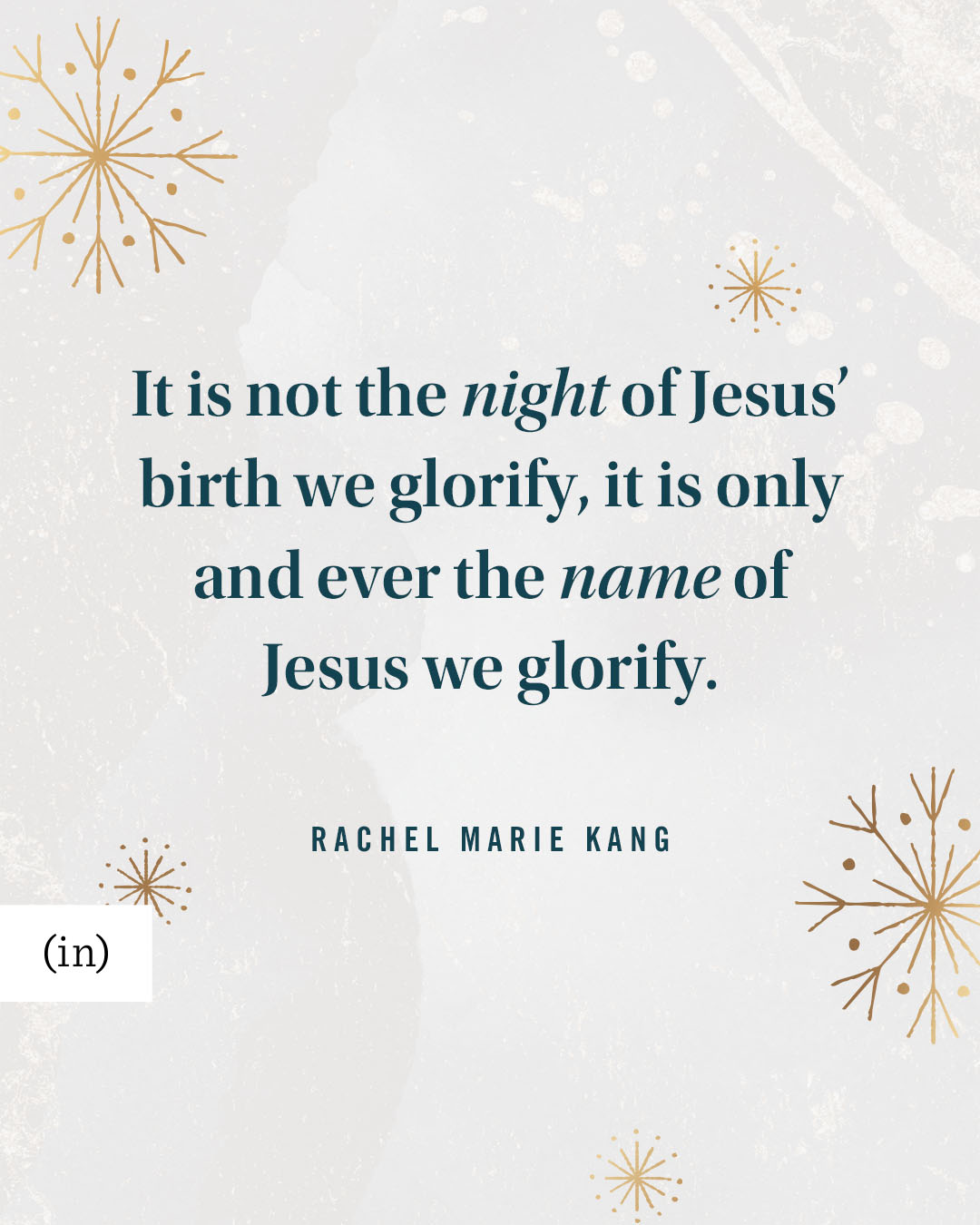
It is not the night of Jesus’ birth we glorify, it is only and ever the name of Jesus we glorify.
At Christmastime, and at all times, we believe and bear witness to the truth that Jesus makes glorious the impossible gloom. Through song and deed, we declare that Jesus makes miraculous the mundane and saves the wretched sinner. We repeat and repeat the sounding joy — that Jesus restores that which is beyond repair and makes divine even the darkest night.
This season, let the lyrics of “O Holy Night” (or your favorite Christmas song) prompt you to ponder the powerful One who presides over all nature, all names, and all nights. In all our singing, working, gifting, parenting, cooking, and, yes, even in our email sending, may we honor and extol the only One who is worthy of our wonder and our worship.

My favorite Christmas song is Heaven & Earth but Leslie Odom Jr. The words ” I saw love move heaven to earth” paint a vivid picture of what Christmas is truly about, God’s love,
Dear Rachael……………..My favorite hymn is just the one you have explained to us the history of. Thank you for that. One thing that I discovered besides what you told us is the Wise Men were not there until a couple of years later so there are different perspectives in , for sure, in reading “The Story”. Celine Dion is my favorite person to sing the song that she did in 1998 in a TV show. I play it all throughout the year. It is , to me, the most beautiful hymn at “Christmas “. I still love the old standards but some have forgotten how much they mean to us if we have been church goers for all those years, in my case, the 50’s. Rachael I loved your story of the perfect hymn. I didn’t know these things. Rachael, I send my love and best wishes to you and your family for a bright Christmas and a prosperous New Year as we battle through the world as we know it now. It is upside-down right now, but God will help us. That I am sure of…………………..Betsy Basile
Thank you Rachel for that enlightenment of “O Holy Night”
Merry Christmas ✨
So beautiful and to learn of the origin, of, yes O Holy Night has and always will be my favorite Christmas song.
Merry Christmas to all – and as Tiny Tim says “God Bless Us Everyone”
This is my Grown up Christmas Wish….sung by Amy Grant and Natalie Cole…..beautiful!
I do appreciate some of the bits in “O Holy Night” but also “I Heard the Bells on Christmas Day” and the third verse in “It Came upon a Midnight Clear” where it calls to those who are burdened to rest; also the advent hymns; at this point I really, really appreciate songs that have at least parts where they acknowledge that things are not okay yet – we are being saved *from* some Stuff – and therefore allowing redemption to have weight rather than being flimsy papier-mache or gilding over rotten wood that changes whether things look okay without changing what they *are*. God sees and knows, and will change things all the way through, down to the very last ache, but it’s not done yet, and some number of Christmas songs remind us that we can still hurt while there are glorious things going on, but *also* that we can still have hope for a good and ultimate resolution while we are in the middle of wherever we are, and I love that.
My favorite Christmas songs are “Somewhere In Your Silent Night (Casting Crowns), Anything sang by Celine Dion, Josh Groben and many more, even some of the older ones from my parents days. Merry Christmas. (remembering those that have passed and we miss them so much).